
GuidelinesRegulatory updates2026.11.01
PPWR Responsible Operators and Internal Role Allocation — Manufacturer and Importer Determination Table and a Task Table for Purchasing, Quality, Development and Export Sales
In OEM and ODM exports, a contract clause saying ‘the factory is responsible’ does not decide who the PPWR manufacturer is. The legal role is determined first by the Article 3 definitions and the obligations in Articles 15, 16, 18 and 21; beneath that, purchasing, quality, development and export sales divide the document work. This guide sets out a determination table by trade structure, an obligations summary by role, an internal task table, contract review items and a fictional example.
Key takeaway — The first question in PPWR preparation is not ‘who will handle it’ but ‘who is the legal manufacturer, importer or supplier’. Determine the roles under the Article 3 definitions and Article 21, then decide beneath that in what order purchasing, quality, development and export sales collect, review and hand over documents. Keep a ‘legally obliged party’ column and an ‘internal owner’ column separate in the management table.
This article is based on Regulation (EU) 2025/40 (PPWR) and Commission Notice C/2026/3084 (implementation guidance), as checked on 6 October 2026. For scope and timelines, see the PPWR preparation guide first.
Starting point: each piece of packaging has one manufacturer
Article 3(1)(13) defines the manufacturer as a person who manufactures packaging or a packaged product, with two provisos. (a) Where a person has packaging or a packaged product designed or manufactured under its own name or trademark, that person is the manufacturer even if another trademark appears on the packaging. (b) Where that person is a micro-enterprise under EU Recommendation 2003/361/EC and the person supplying the packaging is located in the same Member State, the packaging supplier is the manufacturer.
Section 2 of the Commission guidance explains it this way. The person who physically produces the packaging is not necessarily the manufacturer; the test rests on two elements, the role in design and manufacture and the trademark. There is always only one manufacturer under PPWR in a supply chain. For sales packaging and grouped packaging, the manufacturer is usually the person who applies the final process to the packaging (cutting, filling, sealing) and places it on the market with the product, that is, the filler, which is generally the product brand owner. For transport packaging, it is usually the company that made the packaging, but if the user's name or trademark is on it, the user is the manufacturer. For unbranded packaging, who ordered it and set the design specification is the deciding factor.
The same section explains the micro-enterprise criteria as fewer than 10 employees and an annual turnover or annual balance sheet total not exceeding EUR 2 million. The criteria themselves are set by Recommendation 2003/361/EC.
Determination table by trade structure
The table below applies the legal text and the guidance to trade structures. The right-hand column is the usual outcome as the guidance describes it; the actual determination is confirmed for each packaging layer and the contract terms.
| Trade structure | First question | Basis | Usual outcome |
|---|---|---|---|
| Korean company produces directly under its own trademark and exports | Who holds the trademark and design decision rights? | Article 3(1)(13)(a) | The Korean company is the manufacturer of the sales packaging |
| Korean brand outsources to a domestic OEM factory | Under whose name or trademark was the packaging made? | Same point (a), guidance Section 2 | The brand is the manufacturer. The factory is on the supplier side, taking on the packaging production work |
| ODM (factory designs, sold under the brand's trademark) | Not who designed it, but under whose trademark it was made | Same point (a) | The brand is the manufacturer |
| Unbranded transport box | Who ordered it and set the specification? | Guidance Section 2 | Usually the box manufacturer. If the user's trademark is on it, the user |
| Brand is a micro-enterprise and the packaging supplier is in the same Member State | Are both conditions met? | Article 3(1)(13)(b), Article 15(12) | The packaging supplier is the manufacturer |
| EU importer repackages and places on the market under its own trademark | Placing on the market under its own name or trademark, or a modification that may affect compliance? | Article 21 | That importer is considered the manufacturer |
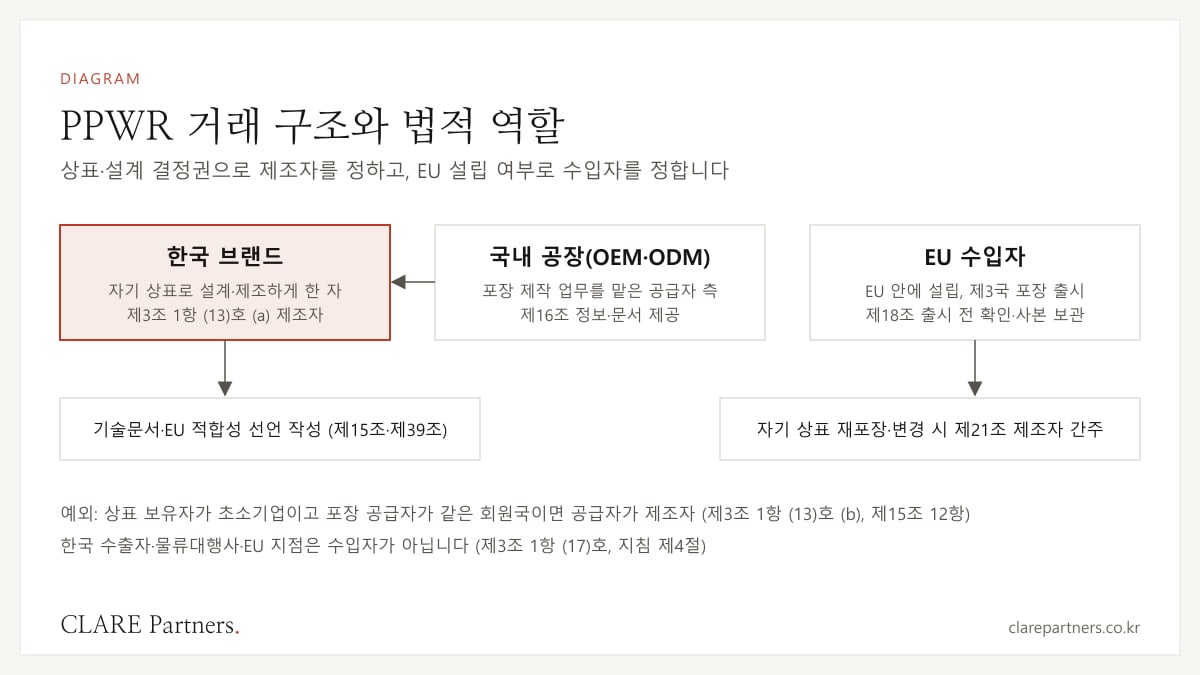
Under Article 3(1)(17), the importer is a person established within the EU who places packaging from a third country on the EU market. Section 4 of the guidance reads the establishment requirement as a person with legal personality having a registered address in a Member State, and explains that a branch without legal personality cannot be the importer. The same section explains that a third-country manufacturer with only a branch in the EU must set up a subsidiary or, where a Member State requires it, appoint an authorised representative under Article 3(1)(19). A Korean exporter or a logistics agent does not fall within this definition.
Obligations summary by role
| Operator | Core obligations | Provisions |
|---|---|---|
| Manufacturer | Place on the market only packaging that complies with the requirements of Articles 5 to 12 · conformity assessment under Article 38 and technical documentation under Annex VII · EU declaration of conformity · retention for 5 years (single-use) or 10 years (reusable) · reassessment on changes · identification information and name and address marking · corrective action and notification of authorities in case of non-compliance · provision of information within 10 days of a request | Article 15(1) to (8), (10) |
| Supplier | Provide the manufacturer with all information and documentation necessary for the manufacturer to demonstrate compliance, in a language easily understood by the manufacturer. For contact-sensitive packaging, include documents under the relevant EU legislation | Article 16(1), (2) |
| Importer | Before placing on the market, verify the manufacturer's conformity assessment, technical documentation, marking, accompanying documents and compliance with Article 15(5) and (6) · indicate its own name and address · manage storage and transport conditions · corrective action in case of non-compliance · keep a copy of the declaration and keep the technical documentation available · provide information within 10 days of a request | Article 18(1) to (9) |
| Importer or distributor considered a manufacturer | Where it places packaging on the market under its own name or trademark, or makes a modification that may affect compliance, the Article 15 obligations apply | Article 21 |
Section 2 of the guidance explains that the conformity assessment can be carried out by the manufacturer itself or entrusted to another party such as a test laboratory, and that the declaration is drawn up by the manufacturer or the authorised representative on the basis of information provided by suppliers, but responsibility rests with the manufacturer.
Internal task table: divide by the order in which documents move
Once the legal role is fixed, the next step is internal allocation. The table below is our own proposal based on document flow, not departments defined by law. Depending on company size, one person may cover several cells.
| Task | Output | Primary owner | Support | Condition for handing over to the next step |
|---|---|---|---|---|
| Packaging identification and specification collection | Components, part numbers, materials, weights and drawing revision dates per packaging number | Purchasing | Development | When every component carries a current part number and revision date |
| Supplier document requests and reply management | Request date, reply date, follow-up questions, reply status | Purchasing | Quality | When the part number covered by the document matches the current specification |
| Mapping applicable requirements and reviewing evidence | Evidence per requirement, list of unconfirmed items | Quality | Development, Legal | When confirmed and unconfirmed items are distinguished |
| Packaging protective performance and change impact review | Design rationale, change impact assessment | Development | Quality | When a judgement on whether the change affects compliance has been recorded |
| Compiling requests from countries of sale, importers and buyers | Member State, trading partner, supply date, requested items | Export sales | Legal | When legal requirements and contractual requests are distinguished |
| Maintaining technical documentation and the declaration | Annex VII documentation, declaration version, retention records | Quality | Legal, management signature | When the declaration is linked to the current specification |
| Contact point for importer enquiries | Record of questions and replies, document versions provided | Export sales | Quality | When the version provided has been recorded |
The key to the table is not the owner's name but the last column. Distinguishing the fact that a file was received from the fact that its review was completed lets the remaining work be found even when the owner changes.
Fictional example: Korean Brand A, Factory B, EU Company C
This is a fictional example for illustration. Suppose Korean Brand A orders Factory B to produce cosmetics and sales packaging under A's trademark, and Company C in the EU imports and sells them.
- The manufacturer of the sales packaging is reviewed as Brand A under Article 3(1)(13)(a). Even if Factory B collects the bottle and label supplier documents, this is a division of work, not a change of the legal operator.
- Company C is established in the EU and places third-country packaging on the market, so the importer obligations in Article 18 are reviewed. If Company C repackages under its own trademark, it may be considered the manufacturer under Article 21.
- For the outbound transport box, if it is unbranded the box manufacturer may be the manufacturer; if Brand A's trademark is printed on it, Brand A may be the manufacturer. Each packaging layer is looked at separately.
- Within Brand A, purchasing could handle Factory B and supplier documents, quality the requirement mapping, export sales Company C's document requests and country-of-sale information, with the declaration prepared by quality and signed by management.
This example is not a legal determination of a specific transaction; the outcome changes with the micro-enterprise exception and whether each packaging layer carries a trademark.
Items worth including in the contract
Dividing costs and work by contract is different from changing the party that bears obligations under the Regulation. On that premise, the following can be kept as items for your own review.
- The packaging and part numbers covered by document provision, the language, and the method of delivering revisions (Article 16(1) requires a language easily understood by the manufacturer)
- The timing and contact point for advance notice of changes to specifications, materials or suppliers
- Who answers questions from the importer or authorities, and with which document version
- Access rights to and storage location of technical documentation and test reports
- Whether the counterparty may repackage and resell under its own trademark, and if so, whether both sides recognise the change of role under Article 21
The way change notification and access to source data are agreed in medical device OEM contracts follows the same line as the medical device OEM quality agreement guide.
Common misunderstandings
| Common explanation | What the legal text and guidance provide | What to check |
|---|---|---|
| The contract says the factory is responsible, so the factory is the manufacturer | The manufacturer is determined by the Article 3 definition. The contract only allocates work. | Trademark, design decision rights, micro-enterprise status |
| The Korean exporter acts as the importer | The importer is a person established within the EU. | The establishment form of the EU trading partner |
| We have an EU branch, so we are the importer | Guidance Section 4 does not treat a branch without legal personality as the importer. | Whether there is a subsidiary, whether an authorised representative is needed |
| If the consultant writes the declaration, responsibility passes too | Article 39(4) and guidance Section 2 provide for sole manufacturer responsibility. | The signatory of the declaration and the supporting evidence |
| The importer will take care of it | Article 18 places pre-market verification obligations on the importer. Without the manufacturer's documents, the importer cannot place the packaging on the market either. | Which documents are provided, in which version |
Documents that speed up the review if prepared before enquiring
- A one-page trade structure diagram showing company name, country of establishment, brand, production, export and import roles
- Whether each packaging layer carries a printed trademark, and who designed and ordered it
- A list of who holds the current packaging documents and where
- The establishment form of the EU trading partner and whether it repackages
Please mention PPWR packaging in your message when you use the PPWR role review enquiry. Based on the trade structure diagram and document list, we will indicate the points to confirm for the legal role determination and a starting point for internal allocation. The scope and cost of the review are advised individually after we have confirmed the product and packaging configuration.
Prepared and sources checked: 2026-10-06. Sources: Regulation (EU) 2025/40 Article 3(1)(13), (17) and (19), Articles 15, 16, 18, 21, Article 39(4) · Commission Notice C/2026/3084 Section 2 (definition of manufacturer), Section 4 (importers and branches). The guidance is interpretative material and does not replace the legal text. The determination table, task table, contract items and fictional example are our own practical tools and do not replace a legal determination of an individual transaction.
Frequently asked questions
- Q. If the OEM factory makes the packaging itself, is the factory the PPWR manufacturer?
- Article 3(1)(13)(a) treats the person who has packaging or a packaged product designed or manufactured under its own name or trademark as the manufacturer, even if another trademark appears on the packaging. Even where the factory takes on the packaging production work, the trademark holder is usually the manufacturer. However, there are conditions under which the supplier becomes the manufacturer, such as the micro-enterprise exception in point (b), so this must be confirmed against the trade structure.
- Q. Can a Korean exporting company be the importer under PPWR?
- The importer under Article 3(1)(17) is a person established within the EU who places packaging from a third country on the EU market. A company established in Korea does not fall within this definition. Section 4 of the Commission guidance explains that an EU branch without legal personality cannot be the importer either.
- Q. If we draw up an internal task table, is legal responsibility divided accordingly?
- No. The task table is an internal design for collecting and reviewing documents. Article 39(4) provides that by drawing up the EU declaration of conformity the manufacturer assumes responsibility for the compliance of the packaging, and Section 2 of the Commission guidance explains that the manufacturer bears sole legal responsibility regardless of who actually drafted the declaration.
- Q. What happens if the EU importer removes our trademark and sells under its own?
- Under Article 21, where an importer or distributor places packaging on the market under its own name or trademark, or modifies packaging already placed on the market in a way that may affect compliance, that importer or distributor is considered a manufacturer and is subject to the obligations in Article 15. The micro-enterprise exception in the same article is checked separately.