
GuidelinesImport & customs2026.07.08
Medical Device Import Guide for South Korea — From Import Business License to Customs Clearance
The full path for bringing a foreign medical device into South Korea — import business licensing, product registration, import requirement verification, Korean-language labeling, and UDI registration. Plus the three reasons shipments get stuck at the port.

Key takeaway — Importing medical devices into South Korea is a three-layer structure: qualification (import business license) → product (registration) → logistics (requirement verification and customs clearance). Skip the order in which those layers are built and your goods sit at the port while storage fees accumulate daily. And clearance is not the end — Korean-language labeling, UDI registration, and supply record reporting are the distribution management duties that follow. This guide walks through the whole path as a single flow.
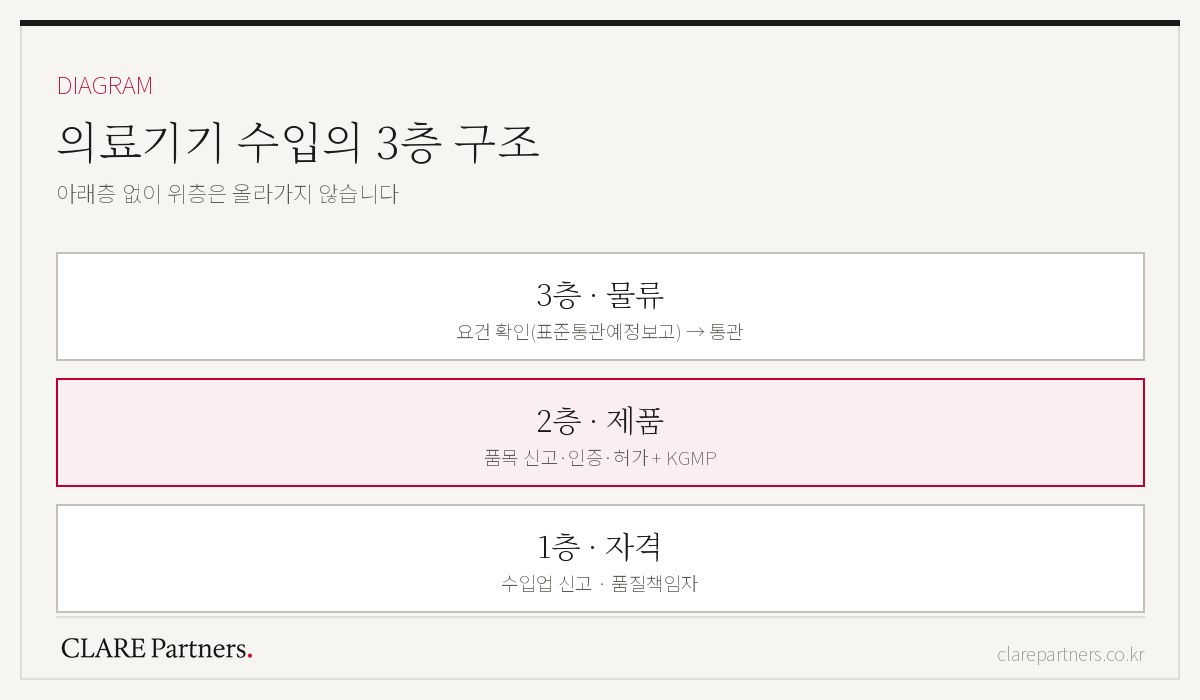
Layer 1 — Import business license: getting qualified
Whatever the product, a company that wants to import and sell medical devices in Korea must first obtain a medical device import business license.
- Appointing a quality manager — You need a person who meets the statutory qualification requirements. For smaller importers, this is the first wall they hit.
- Facility requirements — A business premises and storage conditions appropriate to the products handled.
- Quality documentation — Quality management procedures covering the import and sales process.
That is the "qualification" layer. Without it, no amount of perfection in the layers below will get your filing accepted.
Layer 2 — Product registration: may this device be brought in?
The pathway depends on the device class — Class I notification, Class II certification, and Class III / Class IV approval (full comparison).
What makes importing distinctive is that the owner of the source material is overseas.
- The raw material for the technical documentation sits with the manufacturer — specifications, test reports, material information. How far foreign test reports are accepted in Korea is covered separately in our guide to foreign test report acceptance.
- For Class II and above, KGMP (Korean Good Manufacturing Practice) for the overseas manufacturing site comes as part of the package — impossible without the manufacturer's cooperation in the audit.
- That is why writing document supply and audit cooperation obligations into the supply agreement is the key safeguard at this layer.
Layer 3 — Customs clearance: the day the goods cross the border
Registration in hand, clearance is still a separate gate.
Import requirement verification — Medical devices are subject to requirement verification at customs. In practice this runs through the standard import declaration (pre-clearance report) procedure administered by the Korea Medical Devices Industry Association, where registration data is cross-checked against the details of the imported goods.
Consistency between labels and documents — If the product name or model name on the invoice and packing list differs from the registration certificate, that alone is grounds for a hold. Notation differences that look trivial are not trivial at customs.
HS codes and duties — Tariff rates and applicable requirements change with classification. Where classification is arguable, pre-review with a licensed customs broker is warranted.
Korean-language labeling — one sticker decides your clearance
The item most often pushed to the back of the queue in import projects is the Korean-language label. Under the Medical Devices Act and the Regulation on Labeling of Medical Devices (MFDS (Ministry of Food and Drug Safety, formerly KFDA) Notification), prescribed information must appear in Korean on the container, outer case, and packaging — and this is an obligation that applies before distribution, not at the point of sale.
The broad framework of required label content is below. Items are added or omitted depending on product characteristics (sterility, single use, whether an expiry date applies, and so on), so the actual label must be finalized product by product.
| Category | Representative items | Practical point |
|---|---|---|
| Company information | Importer's business name and address, manufacturer (country of manufacture, manufacturer name) | Must match the registration certificate character for character |
| Product identification | Product name, brand name, model name, approval (certification / notification) number | The rule is three-way consistency between invoice, certificate, and label |
| Traceability | Lot number, date of manufacture, expiry date (where applicable) | If it contradicts the country-of-origin label, expect a deficiency notice |
| Statutory statements | "Medical Device" marking, single-use marking (where applicable), packaging unit | Among the most commonly omitted items |
| Standard code | UDI barcode and code marking (by class) | Covered separately in the UDI section below |
Timing of application is a strategic choice. The textbook picture is having the overseas manufacturing site print and apply the Korean label before shipment. When the manufacturer will not accommodate Korean labels for small orders, the practical route is to obtain approval for rework inside the bonded area, apply Korean labeling stickers, and then clear customs. That route adds approval and processing time, and at volume the labor cost is substantial, so for repeat imports the standard answer is to migrate to manufacturer-applied labels. We are often asked whether the stickers can simply be applied in the warehouse after clearance — but any design that creates a window in which goods are cleared and distributed without labeling is itself a risk. Locking the label artwork before placing the order is by far the cheapest option.
The instructions for use must be in Korean too. A common mistake is translating the label while leaving the instructions for use in the original language. And if the translation introduces wording that differs from the approved intended use, that becomes its own problem — so the translation needs a review pass that aligns it with the language of the registration documents.
UDI codes and supply record reporting — the homework that comes after clearance
Once the goods clear customs it feels like the administrative work is done, but two obligations remain, both handled through the Integrated Medical Device Information System. These are also the first tasks to lapse when the responsible staff member changes.
| Category | What | Who | When |
|---|---|---|---|
| UDI code registration | Apply UDI marking to the product + register the code and product information in the Integrated Information System | Importer (manufacturer) | Before distribution (release) |
| Supply record reporting | Submit supply records including customer, product, and quantity | Manufacturers, importers, distributors, and lessors | Monthly, by the end of the month following the month of supply |
UDI code registration — This is the system for applying an internationally standards-based unique device identifier to the device and registering that code together with the product information in the Integrated Medical Device Information System. It was phased in by class and now applies to all classes. In import practice, registration is often built on international codes the manufacturer already uses, such as GS1, and errors show up most often in how codes are structured by packaging level and in linking the code to the registration data. Whenever a model is added or the labeling changes, the registered information has to move with it, so it is safer to manage UDI registration and change approval / change notification events as a single workflow.
Supply record reporting — This is the monthly report of what was supplied to hospitals, distributors, and other customers, filed through the Integrated Information System. All Class III and Class IV products are in scope. For Class I and Class II, MFDS has narrowed the scope through regulatory improvement, and only a subset — such as treatment materials covered by national health insurance reimbursement — is currently subject to reporting. Whether your own products are in scope depends on the product category and reimbursement listing status, so it is worth settling the question once, early.
The cost of not doing it — Registration and reporting are the kind of obligations where nothing visibly breaks if you skip them, which is exactly how omissions pile up. But failure to register or report is subject to administrative action, and a growing number of customers (hospitals and distributors) check UDI registration status as a condition of supply. Since distribution history is recorded in the system, building a monthly routine is several times cheaper than cleaning it all up retroactively.
Three reasons shipments get stuck at the port
- Requirements not in place — Shipping before the registration and the import business license are finalized. The most common cause, and the most expensive.
- Notation mismatches — Product names, model names, or quantities that disagree across documents.
- Korean labeling problems — Deferring the labeling requirement until after clearance. Response routes such as bonded-area rework approval exist, but they cost time and money.
Principles for designing the import schedule
Decide the shipping date last. Work backward from the completion dates of the import business license and the product registration to set your order and shipping schedule. "Goods first, paperwork while the ship is at sea" comes back as a storage fee invoice in this industry. For a first import in particular, label finalization → manufacturer application (or a rework plan) → standard import declaration → UDI registration is one continuous schedule.
Common grounds for rejection or deficiency notices
- Three-way mismatch of product/model name across invoice, registration certificate, and label
- Goods arriving without Korean labeling, with no rework plan, and clearance attempted anyway
- Approval number or importer details missing from the label, or an outdated version applied
- Instructions for use left in the original language, or a translation inconsistent with the approved intended use
- Errors in UDI code structure by packaging level, or registered data inconsistent with the registration certificate
- Reporting scope never settled, leading to accumulated missed supply reports
Checklist before you proceed
Before ordering and shipping
- Import business license complete, including the quality manager
- Product registration pathway confirmed and underway
- Document supply and KGMP cooperation obligations reflected in the supply agreement
- Invoice wording verified against the registration certificate
- Korean label artwork finalized → manufacturer application agreed (rework plan if not possible)
Before first clearance and sale
- Requirement verification steps, including the standard import declaration, prepared
- Korean instructions for use reviewed for consistency with the registration documents
- UDI code issued and applied, registered in the Integrated Information System (before release)
- Reporting scope for your products settled → monthly reporting routine assigned
Importing is a contest of timing between paperwork and logistics. Send us your product details through a free pre-review before you place the order, and we will build a shipping schedule worked backward from registration, labeling, and UDI.
Frequently asked questions
- Q. What is the difference between the import business license and product registration (certification/approval)?
- The import business license concerns whether your company is qualified to import medical devices at all. Product registration concerns whether this particular device may be imported. You need both, and if you complete the product dossier without the business license in place, your filing will be rejected at intake.
- Q. Are UDI code registration and supply record reporting separate from customs clearance?
- They are separate obligations. Even after clearance, the importer must register the UDI code and product information in the Integrated Medical Device Information System, and if the product falls within reporting scope, supply records must be reported by the end of the month following the month of supply. Clearance is not the finish line — it is where your distribution management duties begin.
- Q. What should we do if a shipment is held at customs?
- The first step is pinpointing the reason for the hold — missing import requirements, labeling problems, document mismatches, and so on. The response differs by cause: supplementing requirements, performing rework in the bonded area, or returning the goods. Since storage fees accrue daily, identifying the cause and deciding on a response quickly is what keeps the loss small.