
GuidelinesBy device type2026.07.08
Ultrasonic Inhaler Approval Guide for Korea
'Ultrasonic inhaler' is a name shared by home nebulizers and surgical aspirators. Which one you have completely changes the class, tests, and timeline.
Key takeaway — With this product, the name itself is the trap. The same term "ultrasonic inhaler" is used for two entirely different products — a home drug inhaler and a surgical aspirator — and which one you have completely changes the class, tests, timeline, and cost. So licensing for this product begins with classification and is decided by classification.
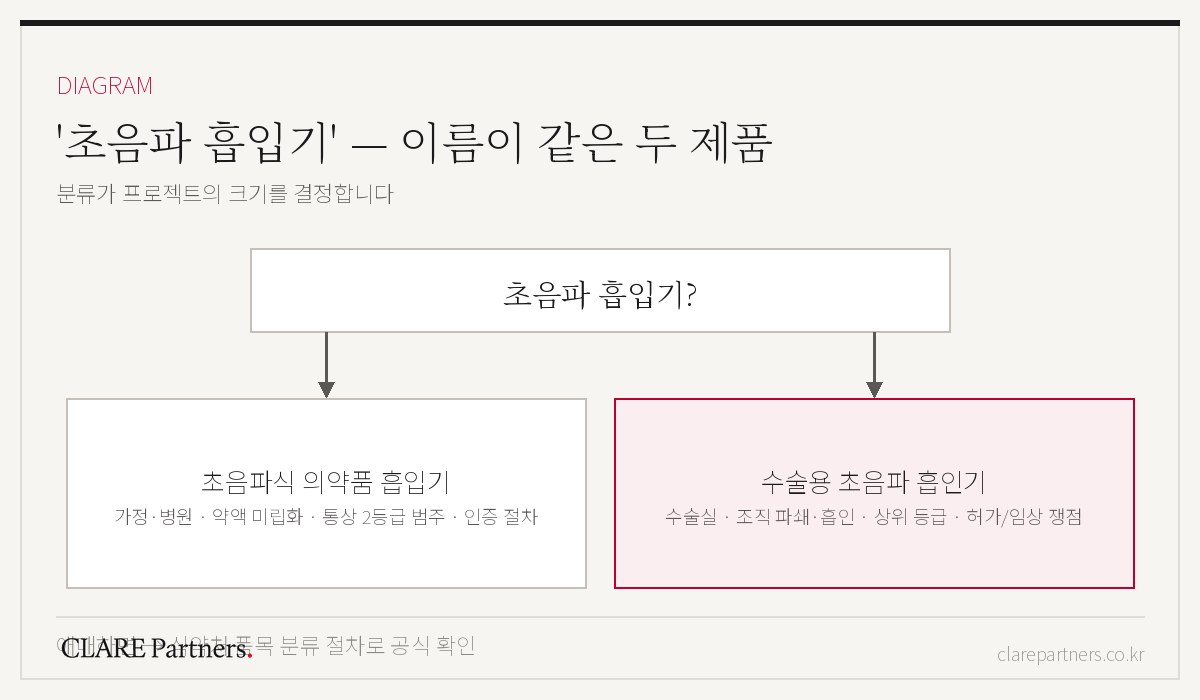
Same name, different products
| Aspect | Ultrasonic drug inhaler | Surgical ultrasonic aspirator |
|---|---|---|
| What it does | Atomizes liquid medication ultrasonically and delivers it to the respiratory tract | Fragments and aspirates tissue with ultrasonic energy |
| Where it is used | Home and hospital (respiratory conditions) | Operating room |
| Regulatory weight | Usually the Class 2 category | Higher class, heavy review data burden |
| Procedure | See the Class 2 certification process | Approval procedure; clinical evaluation may become an issue |
If you sign a sourcing or import contract on the word "inhaler" alone, you are signing up for a completely different regulatory project. Where the classification is ambiguous, obtaining official confirmation through the MFDS product classification procedure is insurance for the entire schedule.
Documents you will prepare either way
Either way, the device uses electricity and acts on the human body, so the skeleton is the same.
Electrical and mechanical safety, and EMC — IEC 60601-1 series, EMC (IEC 60601-1-2). For home use, home-environment conditions are an additional consideration.
Performance testing — For the aerosol type, accredited testing of output rate and aerosol particle characteristics under the conditions set by the product standard is required. For the surgical type, verification of output characteristics and safety functions is central.
Biological safety — ISO 10993 series evaluation of drug-contact and body-contact materials. The point where projects most often stall in practice (see below).
Software documentation — If there is control software, validation documentation according to its classification.
Technical file — Integrating the above results into the logic of intended use, principle, specifications, and testing.
For imported products, add KGMP for the overseas manufacturing site and the manufacturer's document cooperation.
Common missteps in practice
Imported as "home use," but the wording is medical. When the intended-use wording claims treatment of a condition, the class and requirements escalate. Claims are a matter of regulatory design, not marketing.
Trying to substitute catalog figures for performance. The review demands accredited test data. Screening the acceptable scope of the manufacturer's existing reports first reduces duplicate testing.
The material information wall. If the manufacturer holds the drug-contact material information as a trade secret, the biological safety evaluation stalls — and the whole project stalls with it. Putting a document supply obligation into the contract is the only cheap prevention.
Pre-project checklist
- Which of the two categories your product falls into confirmed (official classification if needed)
- Draft intended-use wording and its effect on the class reviewed
- Manufacturer's test report list obtained → acceptable scope in Korea screened
- Supply route secured for drug-contact and body-contact material information
- Document supply obligations reflected in the contract
For this product, a single classification judgment changes the size of the project. One specification sheet is enough for us to point you in the right direction — try a free pre-review.
Frequently asked questions
- Q. What class is an ultrasonic inhaler in Korea?
- It depends on what the product actually is. Home and hospital inhalers that atomize liquid medication are usually reviewed within the Class 2 category, while surgical ultrasonic aspirators that fragment and aspirate tissue sit in higher classes with a heavier review burden. Same name, completely different products in regulatory terms.
- Q. Can the aerosol performance figures in the manufacturer's catalog substitute for testing?
- As a rule, catalog figures are not accepted as review evidence. Accredited testing under the conditions required by the product standard is needed; if the manufacturer holds accredited test reports, checking their acceptable scope in Korea first is the way to reduce costs.
- Q. What if the manufacturer refuses to disclose the drug-contact material information?
- This is the classic situation that blocks the biological safety evaluation. There are two routes — writing a document supply obligation into the contract, or checking whether the upstream raw-material supplier's documents can substitute — and if neither works, you may even need to consider changing manufacturers.