
GuidelinesBy procedure2026.07.08
Complete Guide to Korean Medical Device Approval — Notification vs. Certification vs. Approval
Is your product a notification, certification, or approval? Classification criteria plus a one-page comparison of procedures, timelines, and key documents for all 4 classes.
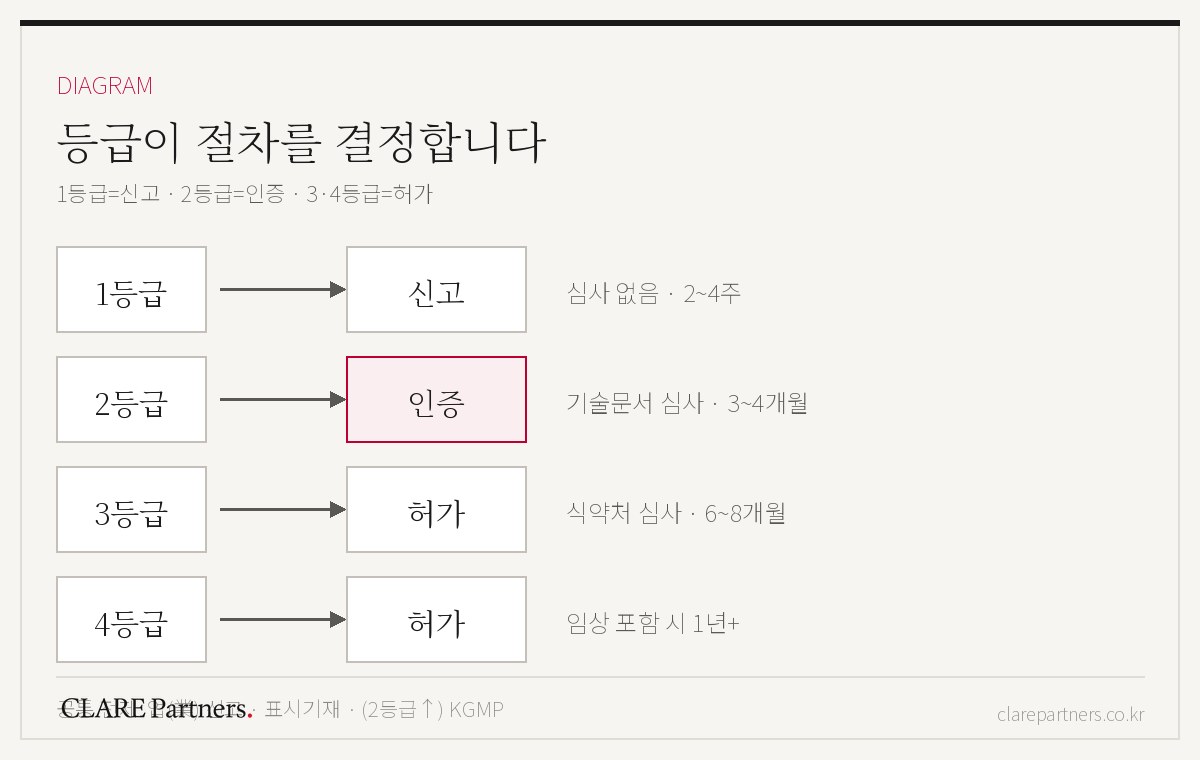
Key takeaway — In Korea's medical device system, the class determines the procedure: Class 1 = notification, Class 2 = certification, Class 3–4 = approval. So the first question of every project is not "how do we get approved?" but "what class is my product?"
The first gate: is it a medical device, and what class?
Whether a product is a medical device is judged not by its performance but by its claimed intended use. The same massage device raises medical device issues if it claims "improved blood circulation and pain relief," but may not if it carries ordinary consumer-product wording. This is why the wording must be designed before development or importing begins.
The class runs from 1 to 4 by potential risk. Body contact site and duration, invasiveness, energy emission, sterility, and measuring functions are among the factors, and where it is ambiguous, obtaining official confirmation through the MFDS product classification procedure is insurance for the entire downstream schedule.
Procedure comparison by class
| Class | Procedure | Review | Typical duration* | Key preparation |
|---|---|---|---|---|
| Class 1 | Notification | None | 2–4 weeks | Product specs, labeling — detailed guide |
| Class 2 | Certification | Technical file review (certification body) | 3–4 months | Test reports, technical file, KGMP — detailed guide |
| Class 3 | Approval | Technical file review (MFDS) | 6–8 months | Class 2 items + advanced data, clinical evaluation if needed |
| Class 4 | Approval | Technical file + clinical review | Can exceed 1 year | Includes clinical trial data |
*Practical, experience-based estimates depending on preparation and deficiency rounds; they differ from the statutory government processing periods.
What is common regardless of class
Whatever the procedure is called, the following apply across all classes.
Business requirements — For imports, an import business license (including a quality manager); for manufacturing, a manufacturing licence — is the prerequisite for the product procedure. See the import process guide for details.
GMP — For Class 2 and above, KGMP conformity assessment effectively comes as a package. Even some Class 1 products, such as sterile devices, fall within scope as exceptions. The KGMP guide covers each audit type.
Labeling and advertising — Korean labeling is a common obligation across all classes, and advertising cannot exceed the approved intended use.
Post-market obligations — Issuance is not the end but the beginning. Change management, renewals, and adverse event reporting follow.
A step-by-step order for first-time applicants
- Fix the intended-use wording → judge whether it is a medical device
- Fix the product name and class → find your procedure in the table above
- Design business requirements and the product procedure in parallel — running them sequentially delays you by exactly that much
- Move to the class-specific detailed guide — prepare testing, documents, and GMP
- Include labeling and advertising review in the launch schedule
The 3 most expensive mistakes
Misjudging the class — Signing the goods contract believing it is Class 1 when it is Class 2. Testing, certification, and KGMP costs plus months are added.
Deprioritizing business requirements — Finishing all the product documents only to find the filing cannot be accepted because the import business license is missing.
Overreaching on intended use — Broadening the claims out of marketing ambition, triggering a chain of class escalation, clinical requirements, and advertising sanctions.
What class your product is, and which procedure applies — this first judgment sets the size of the entire project. Send your product specifications and intended claims for a free pre-review, and we will confirm the class and the regulatory roadmap.
Frequently asked questions
- Q. We don't even know whether our product is a medical device.
- The criterion is the 'intended use.' If the product claims diagnosis, treatment, alleviation, or prevention of disease, treatment of injury, or examination, replacement, or modification of structure or function, it may qualify as a medical device. The practical trap is that the claims you make — not the product's performance — are the standard.
- Q. Who decides the class?
- It is determined by the MFDS product classification system; you can check it against the existing classifications or, in ambiguous cases, obtain confirmation through the official classification procedure. If you proceed on your own judgment and the class later changes, you redo the entire procedure.
- Q. Which takes longest — notification, certification, or approval?
- Class 1 notification typically takes 2–4 weeks, Class 2 certification 3–4 months, and Class 3 approval 6–8 months, while Class 4 can take over a year when clinical trials are required. It varies with your level of preparation and the number of deficiency rounds.