
GuidelinesBy device type2026.07.08
Nebulizer Approval Guide for Korea
Compressor, ultrasonic, and mesh nebulizers — classification, review points, accessory configuration for imports, and KGMP: the practical checkpoints for inhalation therapy devices.

Key takeaway — Whatever the mechanism (compressor, ultrasonic, or mesh), the review asks one question of every nebulizer: "Does it deliver the drug safely, in the specified form?" The center of gravity of the review is aerosol performance, and in import practice the bottlenecks form around contact-part material information and accessory configuration design.
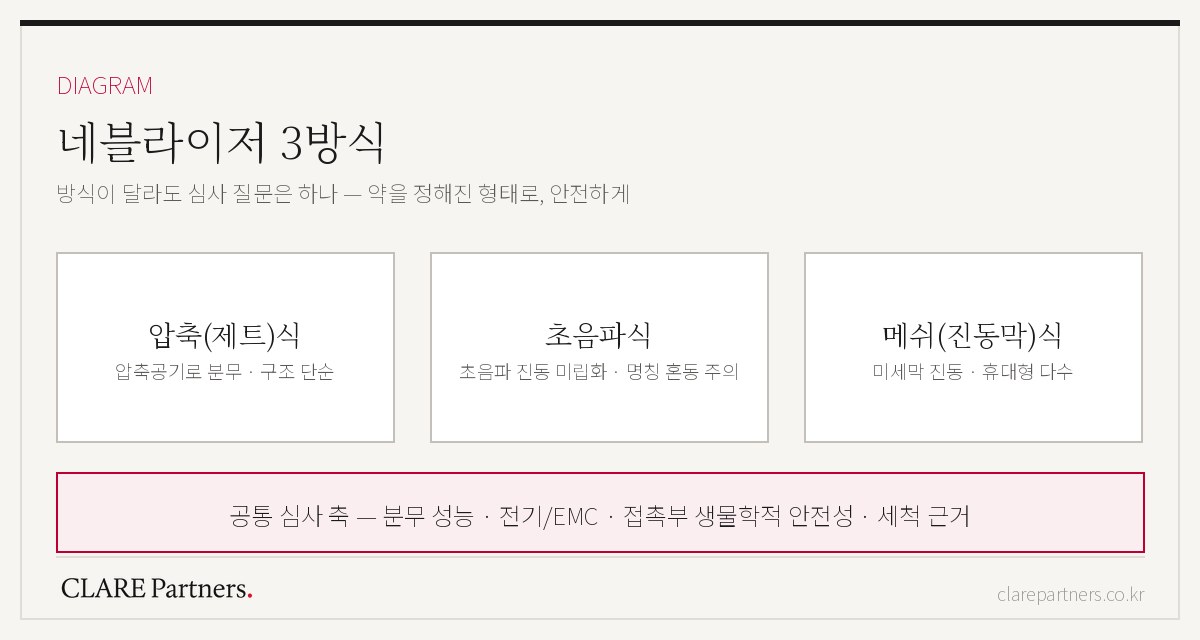
Three mechanisms, one review principle
A nebulizer (drug inhaler) turns liquid medication into an aerosol and delivers it to the respiratory tract.
| Type | Principle | Practical notes |
|---|---|---|
| Compressor (jet) | Nebulizes with compressed air | Simple structure; noise and size |
| Ultrasonic | Atomizes with ultrasonic vibration | Watch the ultrasonic inhaler naming issue |
| Mesh (vibrating membrane) | Vibration of a micro-perforated membrane | Mostly portable; membrane care is the key |
In Korea they are usually reviewed within the Class 2 category, and the overall procedure follows the Class 2 certification guide. This article covers the product-specific points layered on top of that.
The five things the review looks at
1. Aerosol performance — Output rate, aerosol particle characteristics, and the other items set by the product standard. This is the core of the review for this product, directly tied to respiratory delivery efficiency. Testing must be performed under the conditions the standard specifies, and condition mismatches are a classic cause of deficiency.
2. Electrical and mechanical safety and EMC — IEC 60601-1 series. For home use, home-environment conditions are added.
3. Biological safety — ISO 10993 series evaluation of materials in the drug and breathing pathway: medication cup, mouthpiece, mask, and other contact parts.
4. Cleaning and disinfection effectiveness — Hygiene instructions for reusable parts, and their supporting evidence. Writing the procedure in the instructions for use without evidence draws a deficiency.
5. Labeling and instructions for use — Korean-language information written for home users. The word "treatment" cannot exceed the approved intended use.
Import project checkpoints
Start with the manufacturer's document inventory. Screening documents prepared for CE and other overseas registrations for what Korea will accept changes the size of your testing budget.
Design the accessory configuration. Whether masks, tubing, and the like are components of the main unit or separate products splits the certification scope. Regulatory review is needed before finalizing the package configuration.
Overseas site KGMP. Confirm the manufacturer's ability to cooperate with the audit (documents and on-site) before signing the contract. See the KGMP guide for details.
Customs preparation. The import requirement confirmation procedures are covered in the import and customs guide.
Common rejection and deficiency causes
- Aerosol performance test conditions inconsistent with the product standard
- Insufficient contact-part material information (upstream supply chain documents not secured)
- No evidence behind the cleaning and disinfection procedures in the instructions for use
- Mismatch between the accessory configuration and the application scope
Pre-project checklist
- Product name and class confirmed, claims finalized
- Manufacturer's test report list obtained → acceptable scope screened
- Availability of contact-part material information confirmed
- Accessory configuration (included vs. separate) finalized
- Manufacturer's KGMP cooperation confirmed
Even for the same nebulizer, the preparation differs by mechanism and configuration. With just the model name and specification sheet, a free pre-review can frame the test items you will need.
Frequently asked questions
- Q. What class is a nebulizer in Korea?
- It is usually reviewed within the Class 2 category. However, the exact product name and class are fixed by the product's intended use, structure, and claims, so it is safest to confirm the classification before sourcing.
- Q. Do accessories such as masks and mouthpieces need separate licensing?
- It depends on the configuration. They may be included as components of the main unit and certified together, or treated as separate products — and this configuration design changes the scope and cost of notification/certification.
- Q. Can we use the word 'treatment' in advertising for a home-use nebulizer?
- Only within the scope of the approved intended use. Claiming benefits beyond the intended use is subject to advertising regulation, and the right order is to design the intended use around the claims you plan to make.