
GuidelinesBy class2026.07.08
Class 2 Medical Device Certification Guide for Korea
The correct term for Class 2 is 'certification.' Technical file review, testing, and KGMP first appear here — the 5-step process and the 3 variables that drive the timeline.
Key takeaway — Class 2 covers the majority of medical devices on the Korean market and is the first class where technical file review and KGMP come fully into play. Total cost and duration are decided by "what you test, and what you can omit."
The correct name for Class 2 is 'certification'
Class 2 covers medical devices with low potential risk. Procedurally, they are subject to 'certification' via technical file review by a certification body designated by the MFDS (some products, such as newly developed devices, require approval instead), sitting between Class 1 notification and Class 3–4 approval.
In practical terms — if Class 1 is "paperwork," Class 2 onward is the territory of "substantiation." You must prove with test data and documentation that the product is safe and performs as claimed.
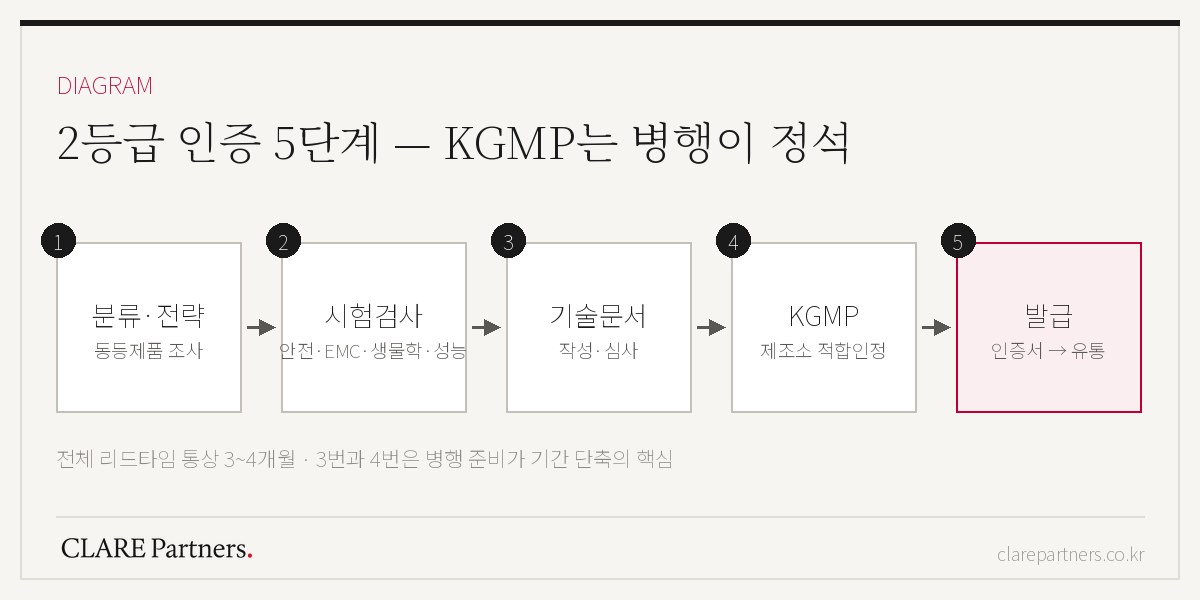
The 5-step certification process
Step 1 — Classification and strategy. Fix the product name and class, and investigate whether an already-approved equivalent (predicate) device exists. The existence of an equivalent device dramatically changes the review burden and the test design, so skipping this investigation inflates costs later.
Step 2 — Testing. Test the product at an accredited testing laboratory. The framework is as follows.
| Test | Applies to | Standard series |
|---|---|---|
| Electrical and mechanical safety | Powered devices | IEC 60601-1 |
| Electromagnetic compatibility (EMC) | Powered devices | IEC 60601-1-2 |
| Biological safety | Devices with body-contacting parts | ISO 10993 |
| Performance testing | All products | Product-specific standards |
The acceptable scope of overseas test reports varies case by case, so screening the manufacturer's existing documents first is the starting point for cost savings.
Step 3 — Technical file preparation and review. Submit a document that weaves the intended use, operating principle, structure and specifications, and test results into a single line of reasoning. What the reviewer reads is not a pile of data but this reasoning.
Step 4 — KGMP conformity assessment. A quality system audit of the manufacturing site (the overseas site, for imports). Detailed preparation is covered in the KGMP Guide, and running it in parallel with the technical file is the key to shortening the timeline.
Step 5 — Certificate issuance → market launch.
For the overall lead time, planning around 3–4 months is realistic, and it swings significantly with the three variables below.
The 3 variables that drive the timeline
1. Thoroughness of the equivalent-device investigation. Starting without it leads to over-designing the test plan (unnecessary cost) or under-designing it (falling back into deficiency responses).
2. Speed of manufacturer document cooperation. The number-one cause of delays in import projects. Material information, test data, GMP documents — the safe move is to specify document supply obligations in the contract.
3. Quality of the first submission. A deficiency notice is not a failure but part of the process — yet the total duration is decided by the first submission. This is where the difference shows between a dossier written knowing the product-specific review points and one written without.
Pre-certification checklist
- Product name and class fixed, equivalent-device investigation complete
- Inventory of the manufacturer's existing test reports secured
- Additional Korean test items, laboratory, and schedule fixed
- KGMP preparation started in parallel with the technical file
- Document supply obligations reflected in the manufacturer contract
For Class 2, the test design is the cost. Send your product details and a list of the manufacturer's existing documents for a free pre-review, and we will frame the required test items and the expected schedule.
Frequently asked questions
- Q. How long does Class 2 medical device certification take?
- It depends on the number of test items, the number of deficiency rounds, and how quickly the manufacturer cooperates with documents; a schedule of around 3–4 months is realistic. It takes longer if there is no equivalent predicate device or if testing must start from scratch.
- Q. Can overseas test reports (CE, etc.) be used for Korean certification?
- Some may be accepted, but whether the test standards and conditions match Korean requirements must be checked case by case. Screening the manufacturer's existing reports for their acceptable scope first can reduce duplicate testing costs.
- Q. Can the technical file review and KGMP proceed at the same time?
- Yes — preparing them in parallel is the key to shortening the timeline. If you submit the technical file and then wait to start KGMP sequentially, the overall schedule stretches by exactly that much.