
GuidelinesBy procedure2026.11.04
Veterinary Medical Device Import Business Licence and Product Import Approval or Notification — A Preparation Table with Company Documents and Product Documents on Two Lines
The import business licence looks at the company's qualifications and facilities; product import approval or notification looks at the product to be brought in. The two procedures are linked by attaching the first item's approval application or notification to the import business licence application. Based on Articles 19-2 and 16 of the Handling Rules, the import establishment facility standards in Annex 6-2, the Government24 processing periods and the fees in Annex 4, this guide sets out a preparation table split into a company line and a product line, a parallel schedule and a document table by owner.
Key takeaway — The schedule needs two lines. The company line is the import business licence under Article 19-2 of the Handling Rules (medical certificates, statement of facilities and equipment, first-item application) and the import establishment facilities under Annex 6-2, Part II; the product line is product import approval or notification under Article 16 (product information, technical documents, test report, certificates of manufacture and sale). The two lines are linked by attaching the first-item application, but they are processed separately, so record the preparation completion date and the planned filing date for each line.
This article is based on the Rules on the Handling of Veterinary Pharmaceuticals, etc. (MAFRA Ordinance No. 741, in force 31 October 2025) with Annex 4 and Annex 6-2, the APQA notice Regulation on the Approval, etc. of Veterinary Medical Devices (No. 2020-19), and the Government24 civil-service guidance, as checked on 6 October 2026. For deciding the item, class and route, see veterinary medical device classification and application route first.
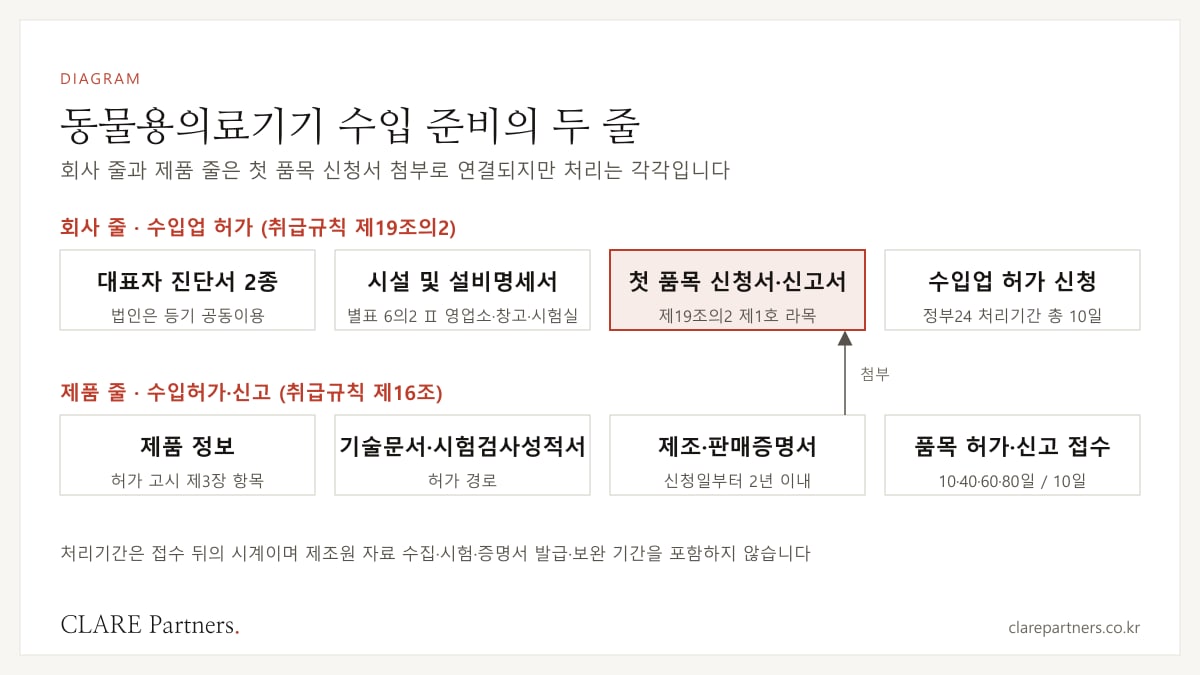
Company line: the import business licence looks at the business
Article 19-2(1) of the Handling Rules requires a person seeking a veterinary medical device import business licence to submit an application in Form 13-2 to the APQA Commissioner with the following documents attached.
| Attachments (Article 19-2(1)(i)) | Note |
|---|---|
| (a) A physician's medical certificate proving that the person does not fall under the main text of Article 6(1)(i) of the Medical Devices Act, or a specialist's medical certificate proving that the person falls under the proviso to that point, issued within the previous 6 months | Not submitted by corporations |
| (b) A physician's medical certificate proving that the person does not fall under Article 6(1)(iii) of the same Act, issued within 6 months | Not submitted by corporations |
| (c) A statement of the facilities and equipment needed for import and quality control | Annex 6-2, Part II standards |
| (d) The veterinary medical device import approval application or notification | Linked to the first item |
Paragraph (2) of the same article provides that for a corporation the official in charge confirms the corporate registration certificate through shared use of administrative information, and paragraph (3) provides that if the application is in order, it is entered in the import business licence register and an import business licence certificate in Form 13-3 is issued. The veterinary in vitro diagnostic medical device import business is provided for separately in point (ii) with the same structure.
The statement of facilities and equipment is not a document that records only an address. Annex 6-2, Part II sets the facilities and facility standards of an import establishment as follows.
| Annex 6-2, Part II | Content |
|---|---|
| 1. Facilities of the import establishment | (a) A business office where import operations are conducted · (b) a warehouse for storing products · (c) where testing is needed for quality control, a laboratory and the test facilities needed for that testing (may be dispensed with where testing is outsourced) |
| 2. Facility standards of the import establishment | (a) Facilities that can maintain the products in their condition at import · (b) cold storage facilities or light-shielding facilities (only for products that need cold storage or whose function is impaired by light) · (c) where handling items with a prescribed storage method, facilities that can maintain those conditions |
If the product's storage conditions are stated in the instructions, facilities that maintain those conditions must exist both in the statement and in actual operation. If you plan to outsource testing, you must be able to describe the scope of outsourcing in the statement.
Product line: product import approval or notification looks at the product
Article 16(1) of the Handling Rules designates as subject to import approval the items in each point of Article 5(1) (Classes 2, 3 and 4, and Class 1 items that are not substantially equivalent), and paragraph (2) designates as subject to import notification the items in each point of Article 5(2) (substantially equivalent Class 1 items). The attachments are as follows.
| Route | Attachments | Provision |
|---|---|---|
| Import approval | Product information under Article 5(3)(ii)(a) (item name and model name, classification number and class, shape and structure, raw materials or ingredients and quantities, manufacturing method, performance and intended use, method of operation or use, packaging unit, storage method and shelf life, precautions, test specifications, manufacturing source, etc.) · technical documents and documents needed for the safety and effectiveness review under (b) · a test report issued by a test laboratory designated under Article 51-3, under (c) · the certificate of manufacture and certificate of sale under Article 16(1)(i)(b) (issued within 2 years before the application date) | Article 16(1)(ii) |
| Import notification | Product information under Article 5(3)(ii)(a) · certificates of manufacture and sale, or documents that can prove the same | Article 16(2)(ii) |
Article 4(1) of the Approval Notice requires applications and notifications to be prepared in accordance with the entry instructions in Chapter 3 of the same notice (Articles 8 to 20) and submitted through the system determined by the APQA Commissioner or on electronic media. How each item of the product information is to be entered is set by that chapter. Which products are subject to approval and which to notification is decided first through the four steps in the classification and application route guide.
Two-line preparation table
Below is our own management table placing the two procedures on one page. Separating shared documents from product-specific documents reduces repeated requests for the same documents.
| Line | Document needed | Basis | Owner | Status held | Planned reply or completion date |
|---|---|---|---|---|---|
| Company | Two medical certificates for the representative (individual) or corporate registration (shared use) | Article 19-2(1), (2) | Management support | ||
| Company | Statement of facilities and equipment; description of office, warehouse, laboratory (or outsourcing) | Article 19-2(1)(i)(c), Annex 6-2 Part II | Operations | ||
| Company | Import business licence application | Form 13-2 | Management support | ||
| Product A | Product information (Chapter 3 entry instructions) | Article 5(3)(ii)(a), Approval Notice Articles 8 to 20 | RA | ||
| Product A | Technical documents, safety and effectiveness documents (approval route) | Article 5(3)(ii)(b) | RA, manufacturing source | ||
| Product A | Test report (approval route) | Article 5(3)(ii)(c) | RA, test laboratory | ||
| Product A | Certificate of manufacture, certificate of sale (within 2 years) | Article 16(1)(i)(b) | Export sales, manufacturing source | ||
| Product B | (Same rows as Product A, separately) |
An answer that a document exists is different from an answer that a submittable document exists. Change the status to complete only after confirming the signature, the issuing body, the model covered and the list of attachments.
Processing periods and fees are looked at per application
| Application | Processing period (Government24 guidance) | Fee (Annex 4) |
|---|---|---|
| Veterinary medical device import business licence | 10 days in total | KRW 30,000 (point 11) |
| Veterinary medical device manufacturing (import) notification | 10 days in total | KRW 10,000 per item (point 3) |
| Veterinary medical device manufacturing (import) product approval | Items not requiring review of technical documents, etc.: 10 days in total · Class 1 and 2 requiring technical document review: 40 days in total · Class 3 and 4: 60 days in total · items requiring safety and effectiveness review: 80 days in total | KRW 10,000 per item (point 3) |
| Change approval or notification for a manufactured or imported item | KRW 5,000 per item (point 4) |
Government24 states that processing periods of 6 days or more are calculated excluding Saturdays and public holidays. The processing period is the clock after filing, not the whole preparation period including collecting manufacturer documents, testing, certificate issuance and responding to a request for supplementation. The fee is the amount paid to the government and is distinguished from testing costs, issuance costs, translation costs and agency fees.
Fictional example: one business, two candidate products
Suppose fictional importer C introduces two types of equipment. On C's company line, collect the medical certificates or corporate registration and the statement of facilities and equipment; for Products A and B, prepare for each a list of intended use, models and test data. Do not conclude that the two products share the same route before reviewing the documents. Even with the same manufacturing source, if the model name, contact materials or performance differ, the evidence to review differs, and the business licence number does not become the product approval number of a new product.
C can file the import business licence application with Product A's import approval application attached, and file Product B as a separate product application once its documents are ready. This example is not the procedural outcome for a specific company.
Set the filing points by linking them
- Fix the company line's facilities and equipment to the product's storage conditions.
- On the product line, fix the route (approval or notification) and the list of documents needed.
- Request first the documents that take time for the manufacturing source to answer (technical documents, test data, certificates).
- Once the first-item application is ready, attach it to the import business licence application, file, and manage the processing periods of the two applications separately.
- Set contract, shipping and sales schedules by preparation completion date and planned filing date, not by a single processing-period figure.
Common misunderstandings
| Common explanation | What the provisions and guidance provide | What to check |
|---|---|---|
| With a business licence we can import any product | Each item needs approval or notification under Article 16. | Route and documents per product |
| Product review starts after the business licence | The structure attaches the first-item application to the import business licence application. | Documents that can run in parallel |
| A warehouse address completes the facility requirements | Annex 6-2, Part II requires an office, a warehouse, a laboratory (where needed) and facilities maintaining storage conditions. | Product storage conditions |
| We ship to fit the 10-day processing period | The processing period runs after filing and excludes preparation and supplementation periods. | Preparation completion date |
| The fee is the total cost | The Annex 4 fee is the amount paid to the government. | Testing, issuance, translation and agency costs |
The fees and statutory periods for the human-use medical device import business licence and product procedures are in the one-page table of medical device fees and statutory periods. Veterinary devices have different provisions and amounts, so that table is not used as it is.
Documents that speed up the review if prepared before enquiring
- Business form (individual or corporation) and plans for the office, warehouse and laboratory
- Instructions, model list and storage conditions for the first product to be introduced
- List of documents the manufacturing source has said it can provide
Please mention veterinary medical devices in your message when you use the veterinary import preparation review enquiry. We will set out who prepares which documents on the company line and the product line. Agency fees are quoted separately according to the number of products and the scope of review. The scope of services is on the veterinary medical device services page.
Prepared and sources checked: 2026-10-06. Sources: Rules on the Handling of Veterinary Pharmaceuticals, etc. Article 5(3), Article 16(1) and (2), Article 19-2, Article 56, Annex 4, Annex 6-2 Part II · Regulation on the Approval, etc. of Veterinary Medical Devices Articles 4 and 8 · Government24 import business licence · manufacturing (import) notification · manufacturing (import) product approval. In the amended rules effective 1 January 2027, Annex 6-2 is renumbered Annex 6-5 with identical content. The preparation table, schedule and fictional example are our own practical tools.
Frequently asked questions
- Q. Once we hold an import business licence, can we sell straight away?
- No. The import business licence is a procedure that confirms the importer's qualifications and the facilities and equipment needed for import and quality control; the product actually to be imported must obtain product import approval or be notified item by item under Article 16 of the Handling Rules. Neither procedure substitutes for the other.
- Q. Can the import business licence and the product application be processed at the same time?
- Article 19-2(1)(i)(d) of the Handling Rules lists the veterinary medical device import approval application or notification as an attachment to the import business licence application. Article 8(1)(i) of the Approval Notice provides that the business licence number in the applicant field may be left blank where there is none. The structure is one of preparing company documents and first-product documents in parallel. However, each application is processed separately, so manage the schedules separately.
- Q. Is a warehouse alone enough to meet the import establishment facility requirements?
- Annex 6-2, Part II requires an import establishment to have a business office where import operations are conducted, a warehouse for storing products, and, where testing is needed for quality control, a laboratory and the test facilities needed for that testing, which may be dispensed with where testing is outsourced. As facility standards it requires facilities that can maintain the products in their condition at import, cold storage or light-shielding facilities for products that need them, and facilities that can maintain the conditions for items with a prescribed storage method.
- Q. If the processing period is 10 days, will the licence certificate be issued ten days later?
- Government24 gives a total processing period of 10 days for the import business licence and for manufacturing (import) notification, and states that processing periods of 6 days or more are calculated excluding Saturdays and public holidays. This is the processing period after the application is received; it does not include the preparation time before filing, such as collecting manufacturer documents, testing and certificate issuance, or any supplementation period.