
GuidelinesImport & customs2026.11.17
Overseas supplier candidates: a regulatory checklist to review before price and MOQ
Whether the factory with the lowest unit price can also provide the documents for a Korean approval has to be checked separately. This guide sets out the items to check at the candidate stage, from the item and class, whether the product has already entered Korea and whether the supplier will cooperate with the manufacturing site's quality management system inspection, to change notification, labels and the sample import route, split into legal basis and practical questions.

Key takeaway Before ranking overseas suppliers by unit price and MOQ, look first at which procedure the product goes through in Korea, and whether the supplier can provide the documents and inspection cooperation that procedure needs. Article 15 of the Medical Devices Act makes the company's import business licence and the product-by-product import approval, certification or notification move as one package, and an approval or certification application is accompanied by proof of the overseas manufacturing site's quality management system. This guide separates what the law requires from practical items worth checking before a contract, and sets them out as a candidate comparison table. The legal wording was compared against the original text in force on 9 November 2026.
What to settle before the price list is the product's Korean procedure
To import medical devices as a business, you must obtain an import business licence (Article 15(1) of the Act). An importer obtains import approval or import certification, or files an import notification, for each product it brings in (paragraph 2 of the same Article), and must proceed with at least one product procedure together with the import business licence application (paragraph 3 of the same Article).
Which product procedure applies depends on the class. Article 4 of the Enforcement Rule, applied mutatis mutandis to imports by Article 34, splits them into approval for Classes 3 and 4, approval or certification for Class 2, and notification for Class 1. Classes are classified and designated by the Minister of Food and Drug Safety according to intended use and potential risk (Article 3 of the Act, Annex 1 under Article 2 of the Enforcement Rule). Do not copy a class the supplier received in another country straight across as the Korean class.
At the candidate stage, first pin down the Korean item name and a likely class. As checked on 9 November 2026, there is an item dictionary menu on the front page of Medical Device Ansim Chaekbang. For products where the judgment could go either way, read it together with the quick guide by item. If the class wavers, all the questions you put to suppliers afterwards waver too.
What the law requires and what to ask the supplier
The middle column of the table below is the wording of the legislation in force. The right-hand column is a set of practical questions on what you need to obtain from the supplier to meet that requirement; it is not a statutory submission list.
| Item to check | What the legislation sets | What to ask the supplier |
|---|---|---|
| Item and class | Splits into import approval, certification or notification by class (Article 15(2) of the Act, Articles 4 and 34 of the Enforcement Rule) | Intended use, model list, components |
| Technical documents | Technical documents etc. attached to approval or certification applications (Article 30(1)1 and (2) of the Enforcement Rule) | List of documents it can provide, language, revision numbers |
| Manufacturing site quality management system | Documents proving the manufacturing site's manufacturing and quality management system attached to approval or certification applications (Article 30(1)2 of the Enforcement Rule), conformity recognition (Article 28(1) of the Act) | Actual manufacturing site address, willingness to cooperate with inspection |
| Labelling | Importer's trade name and address on the container and outer packaging, and for imported products the manufacturer (country of manufacture and manufacturer name) (Article 20 of the Act), labelling in Korean (Article 44 of the Enforcement Rule) | Where and how the Korean label will be applied |
| Import management | The import management standard document includes how to contact the manufacturer and items for checking manufacturing and quality control status (Article 33(1)8 of the Enforcement Rule) | Quality contact point, regular provision of documents |
| Safety information | Reporting and safety measures on becoming aware of new safety data or adverse event cases (Article 33(1)14 of the Enforcement Rule), recall where harm is feared (Article 31(2) of the Act) | How it will notify overseas complaints and recall information |
The obligations in the table fall on the Korean importer, not on the supplier. So if the supplier does not cooperate, the importer has fewer ways to meet its obligations. That is why these columns are asked about when choosing candidates.
Check whether the same product has already entered Korea
As checked on 9 November 2026, the Medical Device Ansim Chaekbang menu has an item and company search. Search by supplier name, product name and model name for existing approvals, certifications or notifications. The search results have two uses.
First, the scope of document preparation. If it is proven, as determined by the Minister of Food and Drug Safety, that the product to be imported is the same product from the same manufacturer (where the country of manufacture, manufacturer and manufacturing site are the same) as an already approved product, the submission of technical documents etc. can be omitted (proviso to Article 30(1)1 of the Enforcement Rule). Also, if another manufacturer or importer has had an on-site inspection and document review of that manufacturing site and holds a valid certificate of conformity, the case is one where the KGMP inspection is done by document review only (Medical Device Manufacturing and Quality Control Standards, MFDS Notice No. 2026-46, hereafter the KGMP Notice, Article 6(2)3). If a ground for on-site inspection in paragraph 3 of the same Article applies, such as a manufacturing site of concern, an on-site inspection is carried out.
Second, commercial terms. The existing approval belongs to the importer that imported the product, and succession to that status is provided for in cases such as a business transfer or merger (Article 47(1) of the Act). It is wise to ask before the contract whether the supplier has an exclusive contract with an existing Korean importer and what happens if the business relationship changes. The structure of approval ownership is set out in the comparison of Korean licence holder structures and the import partner change handover table.
Confirm manufacturer information and document scope in the first reply
The company on the quotation, the manufacturer on the label, the applicant on the test report and the site on the quality certificate can all differ. Getting the actual manufacturing site address and each company's role in the first reply reduces mismatched documents later. The method of matching is in the manufacturer name and address matching table.
For technical documents and test reports, ask about the scope of provision and the language together. The schedule differs depending on whether only a summary can be given or the full report, and on the confidentiality terms. The order for building a request table continues in requesting documents from overseas manufacturers.
Ask about willingness to deal with KGMP at the candidate stage
A person intending to obtain an import business licence and an importer must undergo an inspection by the Minister of Food and Drug Safety of the manufacturing and quality management system and obtain conformity recognition, which is valid for three years (Article 28(1) and (3) of the Act). An importer must import and sell medical devices manufactured in conformity with the standards in Annex 4, item 3 (Article 33(1)15 of the Enforcement Rule). For Class 1, the conformity recognition inspection etc. can be excluded under Article 3(2)2 of the KGMP Notice. Even where the inspection is excluded, the duty to comply with the standards remains (standards that remain for Class 1 sterile products).
For a Class 2 to 4 candidate, show the supplier in advance the documents it would actually need to provide. Article 7(1) of the KGMP Notice lists as inspection application documents an overview of the manufacturing site and the address of each facility, floor plans and equipment lists, the quality manual, finished product test procedures and test reports for representative items, purchasing and outsourcing procedures and the names of major suppliers, among others. The same paragraph provides that the manufacturing site must have a quality control record of at least one manufacturing lot. If documents cannot be submitted for reasons such as trade secrets, there is a route for requesting an on-site inspection (Article 6(3)3). A supplier that says neither document submission nor an on-site inspection is possible is a candidate with high schedule risk, whatever its unit price.
Put change notification, labels and the sample route in the comparison table too
An importer must obtain change approval etc. when matters approved, certified or notified change (Article 12 of the Act, applied mutatis mutandis by Article 15(6)). Some changes, such as a change in the location of an overseas manufacturing site, require conformity recognition again (Article 28(1) of the Act). We recommend agreeing before the contract when the supplier will notify you of a manufacturing site relocation or a change of material, process or key components. Notification clauses were covered in the OEM quality agreement.
Labels are written in Korean, or in a foreign language of the same size alongside Korean (Article 44(1)1 of the Enforcement Rule). Whether the supplier will print the Korean label or it will be applied in Korea changes both the unit price and the import management records. For item-by-item standards, see the labelling guide.
For samples, decide the purpose first. Article 32(1) of the Enforcement Rule places medical devices imported for approval, certification or notification (item 4), medical devices for research purposes such as product development (item 5) and medical devices for testing and inspection under Article 27 of the Act (item 5-3), among others, outside the import business licence etc. The confirmation procedure follows a notice (paragraph 2 of the same Article). The differences by route are in bringing in samples for testing and exhibitions.
Fill the candidate comparison table with three statuses
| Item | Basis for treating it as confirmed | Situations to keep as conditional |
|---|---|---|
| Item and class | Korean item name and likely class match the intended use | Intended use wording differs by country |
| Existing Korean approval | Ansim Chaekbang search result and relationship with the existing importer confirmed | An exclusive contract with the existing importer remains |
| Manufacturing site | Actual site address and role by process received in writing | Only the brand company's address given |
| Document scope | Full report or a controlled viewing route agreed | Reply says only a summary is possible |
| KGMP cooperation | Written reply accepting submission of application documents or an on-site inspection | Reply says to discuss after the order |
| Changes, labels, samples | Notification method, label location and sample purpose agreed | Notification deadline undecided |
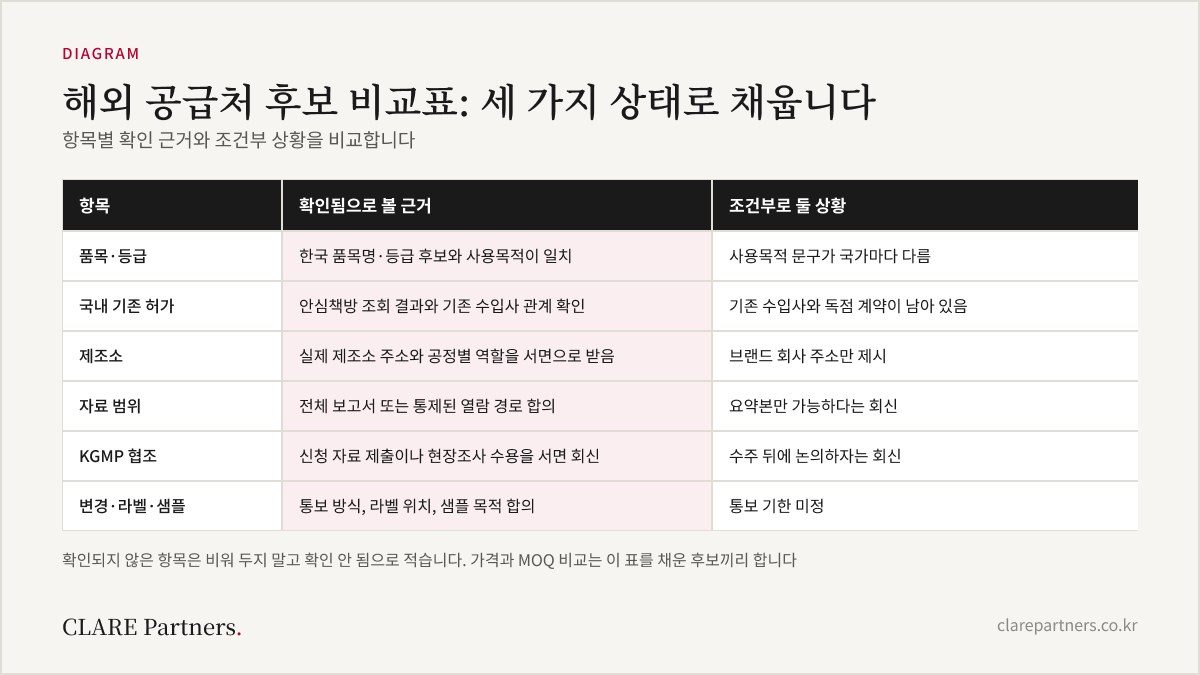
Do not leave an item blank where neither column is confirmed; write it as not confirmed. Comparing price and MOQ only among candidates that have filled in this table turns out quicker in the end. How sourcing-stage documents lead into approval is set out on the manufacturer sourcing service page.
If you send us the candidate suppliers' quotations, product specifications and the list of documents received, we will set out, in a sourcing and OEM consultation, which candidates to screen out first on the basis of the table above and which further questions to ask.
Legal sources: Medical Devices Act (Act No. 22105, effective 20 October 2026) Articles 3, 12, 15, 20, 28, 31 and 47 · Enforcement Rule of the Medical Devices Act (Ordinance of the Prime Minister No. 2127, effective 1 July 2026) Articles 2, 4, 30, 31, 32, 33, 34 and 44, Annex 4 · Medical Device Manufacturing and Quality Control Standards (MFDS Notice No. 2026-46) Articles 3, 6 and 7. Legal wording and Medical Device Ansim Chaekbang menus checked: 2026-11-09. The questions in the right-hand column and the comparison table are practical recommendations and do not replace the statutory submission list for each item.
Frequently asked questions
- Q. If a supplier says it has CE or FDA documents, does the Korean procedure become easier?
- Overseas certification documents can be used as review material, but they do not replace the Korean procedure. An importer must obtain import approval or import certification, or file an import notification, for each product according to its class (Article 15(2) of the Medical Devices Act), and an application for approval or certification is accompanied by technical documents etc. and documents proving that the manufacturing site has a manufacturing and quality management system in place (Article 30(1) and (2) of the Enforcement Rule).
- Q. If the same product has already been approved in Korea, can that approval be shared?
- The existing approval belongs to the importer that imported the product. Succession to that status is provided for in cases such as a business transfer or merger (Article 47(1) of the Act). However, there is a provision allowing the submission of technical documents etc. to be omitted if it is proven, as determined by the Minister of Food and Drug Safety, that the product is the same product from the same manufacturer (proviso to Article 30(1)1 of the Enforcement Rule), so the search results are used to estimate the scope of document preparation.
- Q. Does a Class 1 product also need a KGMP inspection of the overseas manufacturing site?
- Article 3(2)2 of the Medical Device Manufacturing and Quality Control Standards (MFDS Notice No. 2026-46) provides that the conformity recognition inspection etc. may be excluded where a Class 1 medical device is to be manufactured or imported. The provision says the standards are to be followed while the inspection may be excluded, so even where the inspection is excluded, including for sterile products, the duty to comply with the standards remains.
- Q. I want to bring in a few samples before sale to check quality. How do I do that?
- Article 32(1) of the Enforcement Rule exempts from the import business licence etc. medical devices imported for approval, certification or notification, medical devices for research purposes such as product development, and medical devices for testing and inspection, among others, and leaves the procedure and issue of confirmations to an MFDS notice (paragraph 2 of the same Article). Each item specifies a purpose, so if the quantity is to be sold after it is brought in, first check whether this route is the right one.