
GuidelinesRegulatory updates2026.11.19
Medical Devices Act amendment effective 10 December (Act No. 21775): preliminary review, emergency introduction devices and AI advertising
Act No. 21775 amending the Medical Devices Act, promulgated on 9 June 2026, takes effect on 10 December. Medical device status and classification are expressly added to the scope of preliminary review, devices for rare diseases needing emergency introduction are renamed emergency introduction medical devices with a designation procedure, and advertising that makes an AI-generated virtual expert appear to recommend a device is banned. Based on the amendment text, this guide sets out the articles that change, when they apply and what companies should look at in advance.

Key takeaway Act No. 21775 partially amending the Medical Devices Act was promulgated on 9 June 2026 and, under Article 1 of its addenda, takes effect on 10 December 2026, six months after promulgation. Three things change. The scope of preliminary review under Article 11 is spelled out as medical device status and classification, documents needed for approval etc., and clinical trial protocols; the devices for rare diseases needing emergency introduction under Article 15-2 are reorganised as emergency introduction medical devices; and a ban on AI virtual expert advertising enters Article 24(2) as a new item 3. Internal documents also need to reflect that the item numbers of the advertising bans each move down by one.
How to tell the current version from the upcoming version on the National Law Information Center is set out in the guide to the structure of the Medical Devices Act and current versions. This article is based on the amendment text obtained on 9 November 2026 and the text of the version effective 10 December 2026.
What changes and when
| Article | Current (until 9 December 2026) | From 10 December 2026 |
|---|---|---|
| Article 11(1) | Request for review of documents needed for approval, certification, notification, authorisation etc. | 1. Medical device status and classification 2. Documents needed for manufacturing approval, manufacturing certification, manufacturing notification etc. 3. Clinical trial protocols |
| Article 15-2 | Supply of devices for rare diseases needing emergency introduction, entrustment to a relevant specialist institution or organisation | Designation as emergency introduction medical devices, duty to survey demand and plan supply, cancellation of designation, entrustment to the National Institute of Medical Device Safety Information |
| Article 24(2) | Items 1 to 7 | AI virtual expert advertising added as item 3; former items 3 to 7 become items 4 to 8 |
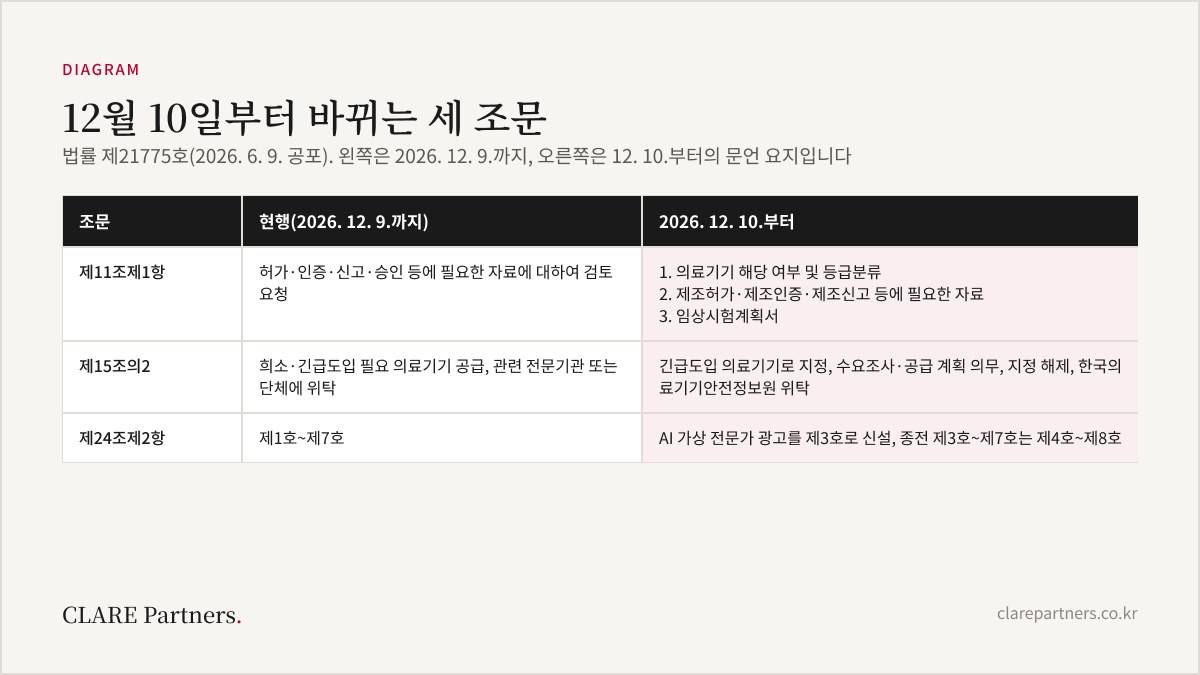
Article 3 of the addenda also changes the same term in Article 10(1)3(b) of the Act on Support for Catastrophic Medical Expenses to emergency introduction medical devices.
Preliminary review: the route for asking about status and classification is written into the Act
Article 11(1) allows a person intending to obtain manufacturing approval or certification or to file a manufacturing notification, and a person intending to conduct a clinical trial, to ask the Minister of Food and Drug Safety for a review in advance. At present, the scope is written only as documents needed for approval, certification, notification, authorisation etc. After the amendment, it is split into three items. Item 1 is medical device status under Article 2(1) and classification under Article 3(1). Article 15(6) applies Article 11 mutatis mutandis to imports, so the same framework applies when you intend to import.
When it applies is set by Article 2 of the addenda. Item 1 applies to preliminary reviews of medical device status and classification applied for after this Act takes effect. The time of application is the reference point, so if you plan to file in early December, keep this in mind when choosing the application date.
The lower-level rules still need checking. Article 25 of the Enforcement Rule in force on 9 November 2026 (Ordinance of the Prime Minister No. 2127) lists as subjects of preliminary review newly developed and rare medical devices, medical devices needing clinical data, innovative medical devices and investigational medical devices, among others, and splits the filing office between the Minister of Food and Drug Safety for manufacturing approval and clinical trials and the President of the National Institute of Medical Device Safety Information for manufacturing certification and notification. This article does not yet have an item for status and classification. Article 11(4) of the Act leaves the scope, extent and procedure to Ordinance of the Prime Minister, so check again around 10 December whether an amendment to the Enforcement Rule has been promulgated.
Article 11(2) (notifying the applicant of the result) and paragraph 3 (taking the review result into account when granting approval etc.) do not change. Preliminary review remains a review that is taken into account at approval, not a procedure that replaces approval. The order for working out yourself whether a product is a medical device is in the medical device status guide and the overall approval procedure guide.
Emergency introduction medical devices: designation, planning and cancellation in the Act
Article 15-2 is a system under which the Minister of Food and Drug Safety supplies medical devices by means such as importing them, or provides information, to widen treatment opportunities for patients with rare and intractable diseases and others. The eligibility criteria stay the same: medical devices for diagnosing or treating rare diseases for which there is no substitutable product in Korea, and those that the Minister of Food and Drug Safety recognises, or the head of a relevant central administrative agency requests, as needing emergency introduction or support for stable supply for public health.
| Paragraph | Content after the amendment |
|---|---|
| Paragraph 1 | Designate medical devices meeting the criteria as emergency introduction medical devices and supply them or provide information |
| Paragraph 2 (new) | To designate and supply, a demand survey must be conducted and a supply plan drawn up |
| Paragraph 3 | Import and supply, information provision, and demand survey and supply planning work may be entrusted to the National Institute of Medical Device Safety Information, with costs supported |
| Paragraph 4 | When the Institute imports designated emergency introduction medical devices as entrusted work, it may do so without approval, certification or notification, limited to those devices |
| Paragraph 5 (new) | Designation may be cancelled in cases prescribed by Ordinance of the Prime Minister, such as no longer meeting the criteria |
Article 34-2 of the current Enforcement Rule already provides for demand surveys and quarterly, half-yearly and annual supply plans. The reasons for amendment state that the aim is to set out such matters clearly in the Act. The wording on entrusted institutions and organisations is removed from the subjects of reporting and inspection in Article 32(1), and Article 15-2(3) is added to Article 43(1)8, which sets out the Institute's work.
The duties in this article fall on the Minister of Food and Drug Safety and the Institute, and do not place new duties on ordinary manufacturers or importers. A company dealing in items for rare diseases may want to watch the notices to see whether products for the same use are designated or have their designation cancelled.
Ban on AI virtual expert advertising: the new item 3 and the shifted numbers
The new Article 24(2)3 bans the following advertising: advertising that uses virtual sound, images or video etc. that are hard to distinguish from reality and generated using an artificial intelligence system under Article 2(2) of the Framework Act on the Development of Artificial Intelligence and the Establishment of Trust, where there is a risk of misleading people into thinking that a doctor, dentist, Korean medicine doctor, veterinarian, pharmacist, Korean medicine pharmacist, university professor or other expert in a related field endorses, designates, certifies, recommends, instructs on or uses the medical device.
The existing item 2 also bans advertising that uses articles likely to give the misunderstanding that a doctor etc. endorses, recommends or uses the device. The new item 3 separately names the means: virtual voices, images and video created by AI. Article 52(1)1 makes violation of Article 24(2) subject to imprisonment of up to three years or a fine of up to KRW 30 million, so the new item falls within the same penalty range.
| Content | Current item | From 10 December 2026 |
|---|---|---|
| Advertising with suggestive articles, photographs or designs | Item 3 | Item 4 |
| Advertising different from the approved, certified or notified matters | Item 5 | Item 6 |
| Advertising not self-reviewed or different from the reviewed content | Item 7 | Item 8 |
The criteria for judging product listing page wording in the advertising rules for product listings guide give the numbers after 10 December as well.
What companies should look at before 10 December
- In your list of advertising materials, find video, image and audio adverts in which AI-generated people or voices appear like experts, and revise or withdraw them.
- Change the Article 24(2) item numbers in internal advertising checklists, copies of review applications and training materials to the new numbers.
- For development items whose medical device status or class is unclear, schedule the preliminary review application for after 10 December, and check whether the Enforcement Rule has been amended.
- If you deal in items for rare diseases, appoint someone to watch for emergency introduction medical device designation notices.
If you need a review of how the amended articles affect your products, advertising and applications in progress, put together your item list and advertising materials and contact us. Clare Partners will separate what to fix before the effective date from what to apply for afterwards.
Legal sources: Amendment text, reasons for amendment and addenda of Act No. 21775 partially amending the Medical Devices Act (promulgated 9 June 2026, effective 10 December 2026) Articles 11, 15-2, 24, 32 and 43, Articles 1 to 3 of the addenda · Medical Devices Act (Act No. 22105, effective 20 October 2026) Article 11, Article 15(6) and Article 52 · Enforcement Rule of the Medical Devices Act (Ordinance of the Prime Minister No. 2127, effective 1 July 2026) Articles 9, 25 and 34-2. Original texts checked: 2026-11-09.
Frequently asked questions
- Q. If I apply for preliminary review before 10 December, can medical device status also be reviewed?
- Article 2 of the addenda to the amended Act provides that Article 11(1)1 (medical device status and classification) applies to preliminary review applications made after this Act takes effect. Applications made up to 9 December are assessed within the previous Article 11 framework of review of documents needed for approval, certification, notification, authorisation etc.
- Q. Are preliminary review results accepted as they stand at approval?
- Article 11(3) provides that the Minister of Food and Drug Safety must take the preliminary review results into account when granting approval, certification, notification, authorisation etc. The amended Act did not change this paragraph. Article 9(4) of the current Enforcement Rule provides that if the preliminary review result notice is submitted, documents on matters that received a conformity decision need not be submitted.
- Q. Is any use of an AI-generated image of a doctor in advertising banned?
- What the new Article 24(2)3 bans is advertising that uses virtual sound, images, video etc. generated by an artificial intelligence system and hard to distinguish from reality, where there is a risk of misleading people into thinking that a doctor, dentist, pharmacist, university professor or other expert in a related field endorses, recommends or uses the medical device. Whether it applies is judged from the advertisement as a whole, so it is safer to remove scenes in which a virtual person who looks like an expert recommends or uses the product before 10 December 2026.
- Q. Is the system for devices for rare diseases needing emergency introduction being abolished?
- It is not abolished; its name and procedure are reorganised. The eligibility criteria in Article 15-2 (such as medical devices for diagnosing or treating rare diseases with no domestic substitute) stay the same. The Minister of Food and Drug Safety designates and supplies them as emergency introduction medical devices, demand surveys and supply planning become statutory duties, and the grounds for cancelling designation and entrustment to the National Institute of Medical Device Safety Information are written into the Act.