
GuidelinesGMP2026.11.21
A checklist before contracting with a manufacturing site: certificate scope, outsourced processes and willingness to accept inspection
Whether it is a contract manufacturing site in Korea or an overseas manufacturer, some things are hard to change once the contract is signed. This guide sets out how to check, before the contract, the scope and site addresses of the quality management system certificate, the KGMP product groups and existing certificates of conformity, outsourced processes and raw material suppliers, record access and change control, and willingness to accept inspection.

Key takeaway Before contracting with a manufacturing site, check within what scope, where and with whose help the site makes this product. The key points are the certificate's scope and sites, the KGMP product groups, outsourced processes and raw material suppliers, record access, change control and willingness to accept inspection. Of these, items set directly by law are given with their basis articles, and the rest are separated as practical items we recommend checking before the contract. The legislation and notices were compared against the original texts in force on 9 November 2026.
Why a separate pre-contract check is needed
When a Korean manufacturer entrusts manufacturing processes, it need not provide the manufacturing facilities and equipment related to the entrusted processes (proviso to Article 6(4) of the Act, Article 8(2)1 of the Enforcement Rule). To that extent, the quality of those processes comes to rely on the contract site's facilities and operation. Even so, the duty to maintain the manufacturing and quality management system rests with the manufacturer (Article 13(1) of the Act, Article 27(1)10 of the Enforcement Rule).
Importing from an overseas manufacturer has a similar structure. An importer must include in its import management standard document how to contact the manufacturer of the imported medical device and items for checking manufacturing and quality control status (Article 33(1)8 of the Enforcement Rule). With a site that offers no way of checking after the contract, this document is hard to fill in.
An overseas manufacturer sometimes entrusts part of its processes to another factory in turn. Because import approval and certification applications are accompanied by documents proving the quality management system of the manufacturing sites of the imported medical device (Article 30(1)2 of the Enforcement Rule), do not stop at looking only at the contracting party's factory. First obtain a list of where the product is actually made. Screen the regulatory conditions at the candidate stage first with the overseas supplier regulatory checklist.
Read a certificate for its scope and sites first
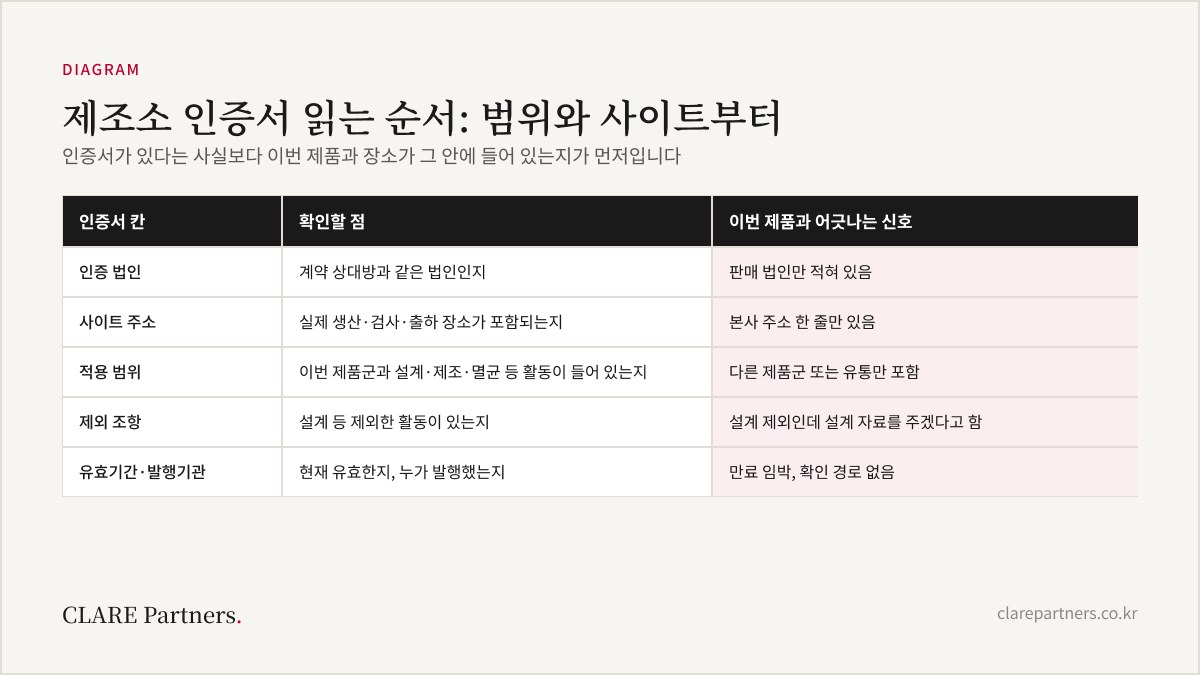
On a quality management system certificate, the scope and site addresses matter more than the company name. We recommend obtaining the certificate text and its annexes and comparing the fields below. This table is a practical checking example, not a form set by law.
| Certificate field | What to check | Signs that it does not match this product |
|---|---|---|
| Certified entity | Whether it is the same legal entity as the contracting party | Only a sales entity is listed |
| Site address | Whether the actual production, inspection and shipping locations are included | Only a single head office address |
| Scope | Whether this product group and activities such as design, manufacture and sterilisation are included | Covers another product group or distribution only |
| Exclusions | Whether activities such as design are excluded | Design is excluded, yet the site offers to provide design documents |
| Validity and issuing body | Whether it is currently valid and who issued it | About to expire, no way of verifying |
A single certificate does not show how the system is running. Ask the site to explain the nonconformities raised in its most recent external audit and the results of the corrective actions. If it is reluctant to disclose them, ask whether you can at least receive a summary, and record the answer in the comparison table.
The relationship between certificates and KGMP is set out in ISO 13485 vs KGMP. For how to match company names and addresses that differ between documents, see the manufacturer name and address matching table.
Check the KGMP product groups and existing certificates of conformity
KGMP conformity recognition is managed per manufacturing site and by product group. Article 4(1) of the KGMP Notice (Medical Device Manufacturing and Quality Control Standards, MFDS Notice No. 2026-46) distinguishes the initial inspection, the additional inspection for adding another product group and the change inspection following a change of location, and paragraph 2 requires a periodic inspection once every three years for each product group. If the candidate site already has a certificate of conformity, first see whether its product group is the same as this product's.
If another manufacturer or importer has had an on-site inspection and document review of that site and holds a valid certificate of conformity, the case is one where only document review is carried out (Article 6(2)3 of the notice). There is also a provision that, for a site that has taken on manufacturing processes from a manufacturing client, the conformity recognition inspection etc. of that site may be excluded where the manufacturing client is changed or added and there is a valid certificate of conformity for the same product group (Article 3(2)3 of the notice). However, if that certificate was issued on document review without an on-site inspection, a valid MDSAP certificate of conformity obtained with an on-site audit must also be submitted (proviso to item (b) of the same subparagraph). As checked on 9 November 2026, Medical Device Ansim Chaekbang has a GMP inspection status menu, so search within what is published, and also ask for a copy of the certificate of conformity and whether an on-site inspection was carried out when it was issued.
Mark outsourced processes and raw material suppliers on the process flow
KGMP inspection application documents include the purchasing and outsourcing procedures for representative items, and the names of major suppliers (including contractors) and their scope of work (Article 7(1)2(f) of the notice). Where applicable, the product standard document including a description of specific manufacturing processes such as sterilisation and software, and the sterilisation validation procedure, are also submitted (item (g) of the same subparagraph). Whether the site can show you these documents before the contract shows, in effect, how ready it is for inspection.
On site, obtain a process flow chart from raw material receipt to shipment and mark the processes done outside. If processes such as sterilisation, plating, injection moulding, printing or testing are handled by other companies, ask for each company's name and location and how they are controlled. We also recommend checking at this stage who approves a change of major raw material supplier.
If testing for quality control is sent outside, look separately at the qualifications of the place doing the testing. Article 8(2) of the Enforcement Rule provides that where testing is entrusted to a medical device testing and inspection body, a non-clinical testing facility, or a manufacturer recognised as conforming under Annex 2, item 2(f), the testing laboratory and related facilities and equipment need not be provided. There is a provision with the same structure for importers (Article 31(2)). If a candidate site says it uses an external test laboratory instead of its own, check which of these that laboratory falls under.
Agree record access and change control in advance
A manufacturer must prepare and keep records for each manufacturing lot and customer complaint handling records, and retain them for five years from the date of manufacture (or, if the product's lifetime exceeds five years, for a period corresponding to that lifetime) (Article 27(1)4 of the Enforcement Rule). An importer likewise retains records for each import lot and complaint handling records for the same period from the date of import (Article 33(1)3). If the original records are held at the contract site or the overseas manufacturer, it is better to settle before the contract how they will be made available for viewing and copying.
The same goes for changes. When the manufacturing site's location changes or a manufacturing site is added, a Korean manufacturer applies for the change, attaching a copy of the entrustment contract (where manufacturing processes or testing are entrusted) and documents proving conformity with the Annex 2 standards (Article 26(1)1 and (3)3 of the Enforcement Rule). Ask when the site will notify you of plans to relocate, replace major equipment or change suppliers, and carry the detailed notification clauses into the contract with reference to the OEM quality agreement.
See whether the site is ready to accept inspection
In a KGMP inspection, the head of the Regional Office of Food and Drug Safety and the head of the quality management inspection body may jointly carry out a document review and on-site inspection of the manufacturing site by product group, and for sites that entrust or take on manufacturing processes, this can be done for both the manufacturing client and the manufacturer (Article 6(1) of the notice). At application, the preferred date for the on-site inspection must be fixed at least 20 days before the start of the on-site inspection (Article 7(1)). If a normal inspection is difficult because the submission of inspection materials is delayed or refused, the on-site inspection may be stopped (Article 8(4)2).
So on a pre-contract visit, look less at the facilities than at the signals given by the people and the records.
| Visit scene | What to look at | What to record |
|---|---|---|
| First meeting | Whether the quality officer attends in person | Name of the contact point for Korean inspections |
| Process tour | Whether the flow chart matches the actual work sequence | Location and company names of external processes |
| Record check | Whether recent manufacturing lot records can be shown straight away | Language of records, storage method |
| Complaints and corrective action | Whether recent handling cases can be explained | Handling period, approver |
| Inspection schedule | Experience of external inspections and how schedules are arranged | Written reply on accepting inspection |
Saying that it is willing to undergo a Korean inspection is different from a written reply. Even if the quotation and MOQ fit, if this field is empty we recommend keeping it as a contract condition. The overall flow of preparing an overseas manufacturing site for inspection is in the KGMP conformity recognition guide.
If you send us the candidate site's certificates, process flow chart and a copy of its certificate of conformity, we will set out, in a sourcing and OEM consultation, the gaps to check before the contract and the questions for the site visit.
Legal sources: Medical Devices Act (Act No. 22105, effective 20 October 2026) Article 6(4) and Article 13(1) · Enforcement Rule of the Medical Devices Act (Ordinance of the Prime Minister No. 2127, effective 1 July 2026) Article 8(2), Article 26, Article 27(1) and Article 33(1) · Medical Device Manufacturing and Quality Control Standards (MFDS Notice No. 2026-46, effective 1 July 2026) Articles 3, 4, 6, 7 and 8. Legal wording and Medical Device Ansim Chaekbang menus checked: 2026-11-09. The certificate comparison table and the visit checklist are practical recommendations, not forms set by law.
Frequently asked questions
- Q. If there is an ISO 13485 certificate, isn't the site check already done?
- The certificate is a starting point. You need to check separately whether the certified legal entity, the site addresses and the scope actually include this product and these processes. KGMP conformity recognition is also a separate inspection under the Medical Device Manufacturing and Quality Control Standards (MFDS Notice No. 2026-46), and holding a certificate is not among the grounds for document review set by Article 6(2) of the same notice.
- Q. If we entrust the whole manufacturing process, can our company have no facilities?
- The proviso to Article 6(4) of the Act and Article 8(2) of the Enforcement Rule provide that, where manufacturing processes are entrusted, the manufacturing facilities and equipment related to the entrusted processes need not be provided. Only part of the facilities is exempted, and the manufacturer must maintain a manufacturing and quality management system (Article 13(1) of the Act).
- Q. Is it an advantage if the candidate site already has KGMP for another company's product?
- If another manufacturer or importer has had an on-site inspection and document review of that site and holds a valid certificate of conformity, the case is one of document review only (Article 6(2)3 of the KGMP Notice). The provision excluding inspection for contract manufacturing sites (Article 3(2)3) is conditional on a valid certificate of conformity for the same product group, and if that certificate was issued on document review without an on-site inspection, a valid MDSAP certificate of conformity obtained with an on-site audit must also be submitted. If a ground for on-site inspection in Article 6(3) applies, an on-site inspection is carried out, so check the product group, validity period and whether there was an on-site inspection together.
- Q. Do we have to visit the site before the contract?
- A pre-contract visit is not a procedure set by law but a checking method the company chooses. However, because a KGMP inspection can include an on-site inspection of the manufacturing site (Article 6(1) of the KGMP Notice), it is useful for seeing the process flow and records in advance and gauging how well the site could handle an inspection. If a visit is difficult, decide what to check instead through a video tour and copies of recent records.