
GuidelinesGMP2026.07.08
KGMP Conformity Assessment Guide — Audit Types, Required Documents, Overseas Site Preparation
KGMP, the rite of passage for Class 2+ devices in Korea. Audit types, the quality system document framework, and the real reasons overseas site audits delay projects.
Key takeaway — KGMP is an audit not of the "product" but of the "system that makes it." It is the de facto rite of passage for Class 2+ medical devices, and in import projects, the overseas manufacturer's level of cooperation is the schedule. ISO 13485 helps, but it is not a waiver.
What KGMP looks at
Where product licensing asks "is this product safe and effective," KGMP (Korea Good Manufacturing Practice for medical devices) asks "can this manufacturing site make such products consistently." The audit target is the site's quality system — documents, records, equipment, personnel, and the shop floor where they actually operate.
For Class 2+ products, conformity assessment of the manufacturing site effectively comes as a package with manufacturing or importing (see the class-by-class procedures), and even some Class 1 products, such as sterile devices, fall within scope as exceptions.
Audit types — which audit, and when
| Audit | When | Characteristics |
|---|---|---|
| Initial audit | First conformity assessment for that site | Documents + on-site, heaviest preparation burden |
| Additional audit | Adding product groups to an already-conforming site | Focused on the scope of change |
| Change audit | Changes to location, critical processes, etc. | Impact assessment of the changes |
| Periodic audit | Renewal when the validity period arrives | Confirms the system is maintained |
For imports, this audit targets the overseas manufacturing site, and the combination of document review and on-site audit is determined case by case.
The quality system document framework
- Quality manual and procedures — The system spanning design, purchasing, production, inspection, release, complaint handling, and CAPA (corrective and preventive action)
- Device master record documents — The standards for 'how the product is made and how it is inspected'
- Records — Evidence that operations actually followed the procedures. What auditors dig into most is not the manual but the records
- Validation — Advance validation of processes whose results cannot be fully verified by inspection, such as sterilization and other special processes
- Training and equipment management — Personnel qualifications and equipment suitability
A site with an ISO 13485 system already has much of this framework. The practical work starts with a gap analysis between "what exists" and "what Korea requires."
Overseas site audits — the real reasons for delay
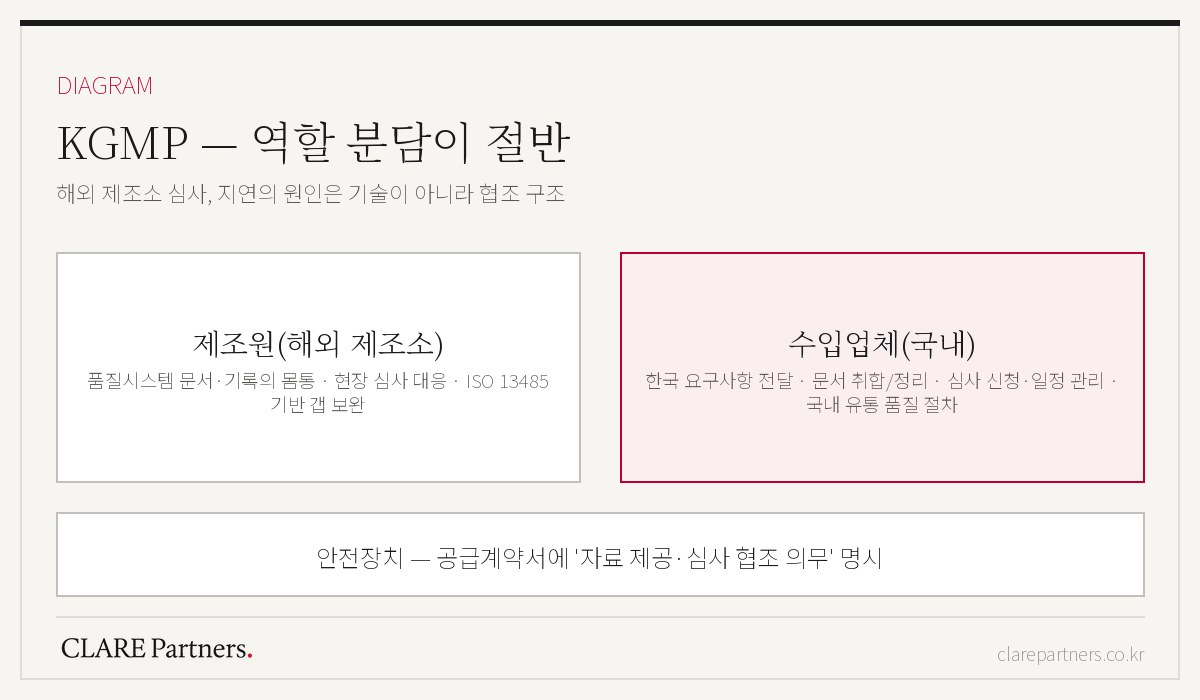
When KGMP falls behind in import projects, the cause is usually not technical but the structure of cooperation.
The "why should we?" wall. From the manufacturer's perspective, KGMP is another country's audit. It routinely slips down their priority list, so an audit cooperation clause in the contract is the only reliable lever.
Document language and format. Underestimating the workload of reshaping the manufacturer's documents into a form Korean auditors can read is how schedules collapse.
On-site readiness. On audit day, the questions go to shop-floor records, not documents. Facing an on-site audit without a mock inspection turns small record gaps into deficiencies.
Preparation checklist
- Target site and product groups fixed, audit type confirmed
- Manufacturer's existing systems (ISO 13485, etc.) confirmed → gap analysis
- Document supply and on-site audit cooperation obligations reflected in the contract
- Schedule secured for document collection, translation, and organization
- Mock on-site inspection planned
- Parallel schedule designed with the technical file review
Half of KGMP is designing the collaboration with your manufacturer. Send the site details (country, existing certifications, product groups) for a free pre-review, and we will draft a gap analysis of the audit type and preparation scope.
Frequently asked questions
- Q. By when must KGMP be obtained?
- It is tied to product certification/approval — to ship and sell the product, the conformity assessment for the relevant manufacturing site must be in place. Preparing it in parallel with the technical file review is the standard way to shorten the overall timeline.
- Q. If the overseas manufacturer holds ISO 13485, is KGMP waived?
- No, it is not waived. ISO 13485 is an excellent foundation for KGMP preparation, but KGMP is a separate conformity assessment against Korean requirements. That said, a site with a well-established 13485 system faces a much smaller gap analysis and remediation scope.
- Q. How is the work split between us as the importer and the manufacturer?
- The body of the work — quality system documents and on-site audit response — belongs to the manufacturer, while the importer handles communicating Korean requirements, collecting documents, filing the audit application, managing the schedule, and the quality procedures for domestic distribution. If this division of roles is not written into the contract, the project stalls in the middle.