
GuidelinesBy class2026.07.08
Class 1 Medical Device Notification Guide for Korea
Class 1 devices proceed by 'notification' with no review. The 4-step process, required documents, and the 3 most common rejection points.
Key takeaway — Class 1 is the only class among the four that finishes with a 'notification' and no review. That makes it fast — and easy to underestimate. Most failures happen not in the notification itself, but before it (product classification) and after it (labeling and GMP-exception checks).
What Class 1 means — 'notification,' not 'approval'
Medical devices in Korea are divided into Classes 1–4 by potential risk. Class 1 covers devices with virtually no risk — examination tables, manual wheelchairs, and surgical knives and scissors are typical examples.
The formal name of the procedure for this class is product notification. You file through the MFDS electronic filing portal without a technical file review by the MFDS, making it the fastest and least costly of the four classes. But approaching it as "just a formality because it's only a notification" leads to rejections. There is no review — yet every requirement must still be met, and the post-notification obligations remain in full.
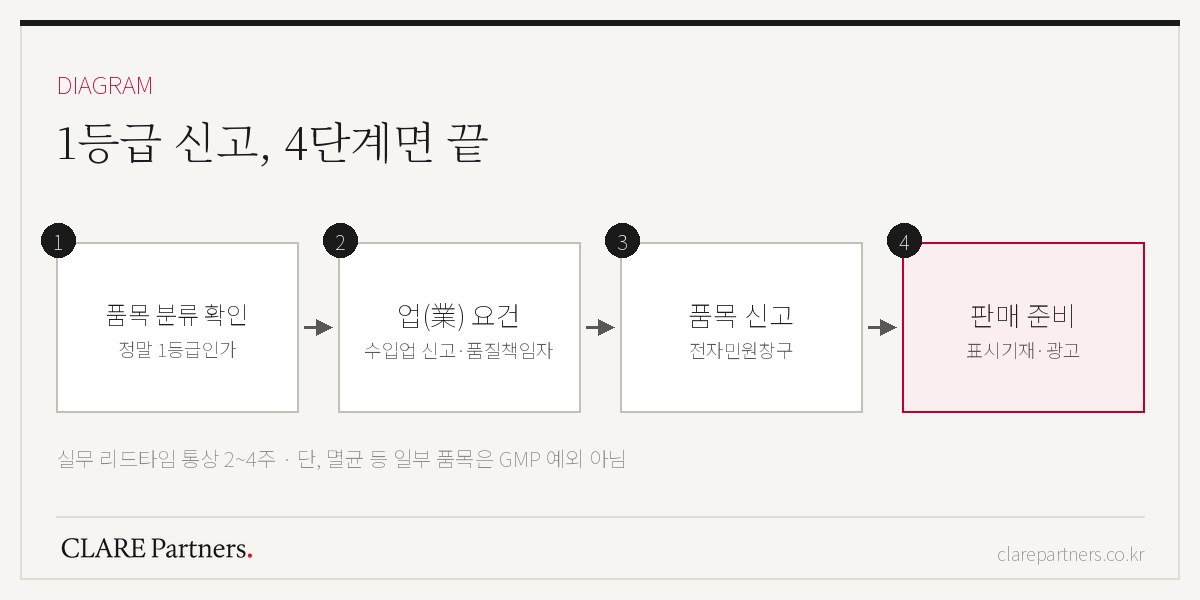
The 4-step notification process
Step 1 — Confirm product classification. First establish that your product really is Class 1. Similar-looking product names often split across different classes, and getting this wrong means redoing everything that follows. (If the class is unclear, start with the classification criteria in the Complete Guide to Korean Medical Device Approval.)
Step 2 — Meet the business requirements. For imported products, an import business license (Medical Devices Act, Article 15) must be obtained before the product notification. This includes designating a quality manager; the requirements for this step are covered separately in the Import Process Guide.
Step 3 — File the product notification. Prepare and submit the notification through the electronic filing portal. Filing and processing is fast, so the practical lead time from document preparation to completion is typically 2–4 weeks.
Step 4 — Prepare for sale. Finalize Korean labeling, complete pre-approval of advertising where required, and meet the other distribution requirements.
Required documents
| Area | Documents | Notes |
|---|---|---|
| Product | Specifications, structure and raw material data | The stated intended use is the basis for classification |
| Manufacturer (for imports) | Manufacturer verification documents, contract documents | Confirm availability before signing the contract |
| Labeling | Draft Korean label | The number-one issue at customs and distribution |
| Business licensing | Quality manager qualification documents, etc. | Handled alongside the import business license |
The 3 most common rejection points
1. Classification errors. "We thought it was Class 1, but it's Class 2" is the most common accident. Sterility, measuring functions, and the mode of body contact can push the class up. In that case you must start over with the Class 2 certification process instead of a notification.
2. Incomplete labeling. Shipping the goods first while missing the Korean labeling requirements, then getting caught at customs or in distribution. Labels are easy to postpone because they are not notification documents — but this is where the real business bottleneck forms.
3. GMP exception errors. Many Class 1 products are exempt from KGMP conformity assessment, but some, such as sterile products, are exceptions. Generalizing to "Class 1 = GMP exempt" is dangerous.
Pre-filing checklist
- Evidence for product classification (product name and class) secured
- Import business notification completed (for imports)
- Availability of manufacturer documents confirmed
- Draft Korean labeling prepared
- GMP exception status of your product confirmed
If the product classification is ambiguous or the availability of manufacturer documents is uncertain, checking the structure before filing is the cheapest insurance. Send your product details for a free pre-review and we will confirm the class and the order of preparation.
Frequently asked questions
- Q. Do Class 1 medical devices also need MFDS approval?
- They are subject to 'product notification,' not approval. You file through the MFDS electronic filing portal without a technical file review — but business requirements such as import business licensing, and labeling obligations, still fully apply.
- Q. How long does a Class 1 notification take?
- Filing and processing itself is fast; the practical lead time including document preparation is typically 2–4 weeks. It stretches further if the manufacturer is slow to supply source documents.
- Q. Is GMP (KGMP) unnecessary for Class 1?
- Most Class 1 products are exempt from KGMP conformity assessment, but some — such as sterile products — are exceptions. Always confirm whether your product falls under an exception before filing.