
GuidelinesBy procedure2026.11.20
Innovative medical device designation in Korea: scope, designation procedure and special approval rules after designation
An innovative medical device is a medical device designated by the Minister of Food and Drug Safety under the Medical Device Industry Act. This guide sets out, against the original legal texts, whether a product falls within an innovative medical device group, what documents the application needs, and what follows designation: staged review, priority review, the deemed business licence, post-market surveillance and cancellation of designation.
Key takeaway An innovative medical device is not a label for any product with new technology. It is a medical device designated by the Minister of Food and Drug Safety under Article 21 of the Medical Device Industry Act. The product must first fall within an innovative medical device group published by the Minister of Health and Welfare, and the Minister of Food and Drug Safety decides on designation within 30 days of receiving the application, in consultation with the Ministry of Health and Welfare. Designation opens special rules such as staged review before approval, priority review and the setting of standards and specifications, but approval itself is not waived. The legal wording was compared against the original texts in force on 9 November 2026.
An innovative medical device is a designated medical device
Article 2, item 4 of the Medical Device Industry Act defines an innovative medical device as a medical device that has significantly improved, or is expected to significantly improve, safety and effectiveness compared with existing medical devices or treatments through the application of advanced technology or improved methods of use, and that has been designated by the Minister of Food and Drug Safety under Article 21. Designation is part of the definition. A company cannot simply call its own product an innovative medical device.
The starting point is the innovative medical device group. The Minister of Health and Welfare designates and publishes innovative medical device groups after deliberation by a committee (Article 20(1) and (3) of the Act). A group designation is valid for three years and can be extended by re-evaluation every three years (Article 20(2)). Article 14(3) of the Enforcement Decree lists the fields for designation, including fields where advanced technology is applied, fields where safety and effectiveness are significantly improved, fields where development of core technology is urgent, and fields of rare and intractable diseases where there is no alternative medical device or domestic supply is difficult. Article 2 of the Regulation on Designation of Innovative Medical Device Groups, a Ministry of Health and Welfare notice, divides these into the advanced technology group, the medical innovation group, the technology innovation group and the public interest medical group.
So the first question is which part of a currently published group your product falls into. If it does not fall within a group, the premise for a designation application is not met. The similarly named innovative product designation for public procurement is not a scheme under this Act, so check it separately.
Designation criteria and application documents
The Minister of Food and Drug Safety may designate a medical device for which an application has been received, taking the following into account, and must consult the Minister of Health and Welfare in order to designate it (Article 21(2) of the Act).
- Whether the technology applied has high technology intensity and a fast pace of technological innovation
- Whether safety and effectiveness have been significantly improved, or are expected to be, compared with existing medical devices or treatments
- Whether it is used for the diagnosis and treatment of rare and intractable diseases and has economic, social and technological ripple effects
- Whether it is used for the rapid diagnosis of infectious diseases and has public interest value and ripple effects
The application is accompanied by the seven documents set by Article 15(1) of the Enforcement Decree: the development history, intended use, principle of operation, method of use, performance, the status of use of similar products in Korea and abroad, and a summary demonstrating that the device qualifies as an innovative medical device. The application and designation certificate forms are set by Article 2 of the Rules on the Support and Management of Innovative Medical Devices, an Ordinance of the Prime Minister.
In practice, we recommend writing the seventh document, the summary, so that it links the six preceding documents to each item of Article 21(2) of the Act. If you claim an improvement over existing products, align the comparator and the indicators with the same figures used in the performance data.
From application to issue of the designation certificate
| Stage | What happens | Basis |
|---|---|---|
| Application | Submit the designation application and the documents in Article 15(1) of the Enforcement Decree to the Minister of Food and Drug Safety | Article 21(1) of the Act, Article 15(1) of the Enforcement Decree |
| Transfer to the Ministry of Health and Welfare | The Minister of Food and Drug Safety sends the documents to the Minister of Health and Welfare without delay | Article 15(2) of the Enforcement Decree, Article 2(3) of the designation procedure notice |
| Group review | The Minister of Health and Welfare reviews whether the device falls within an innovative medical device group and notifies the result | Article 2(4) of the designation procedure notice |
| Decision | Decision on designation within 30 days of receiving the application | Article 21(3) of the Act |
| Certificate and notice | Issue of the designation certificate, entry in the innovative medical device register, publication on the website or similar | Article 15(4) of the Enforcement Decree, Article 21(4) of the Act, Article 2(6) and (7) and Article 4 of the designation procedure notice |
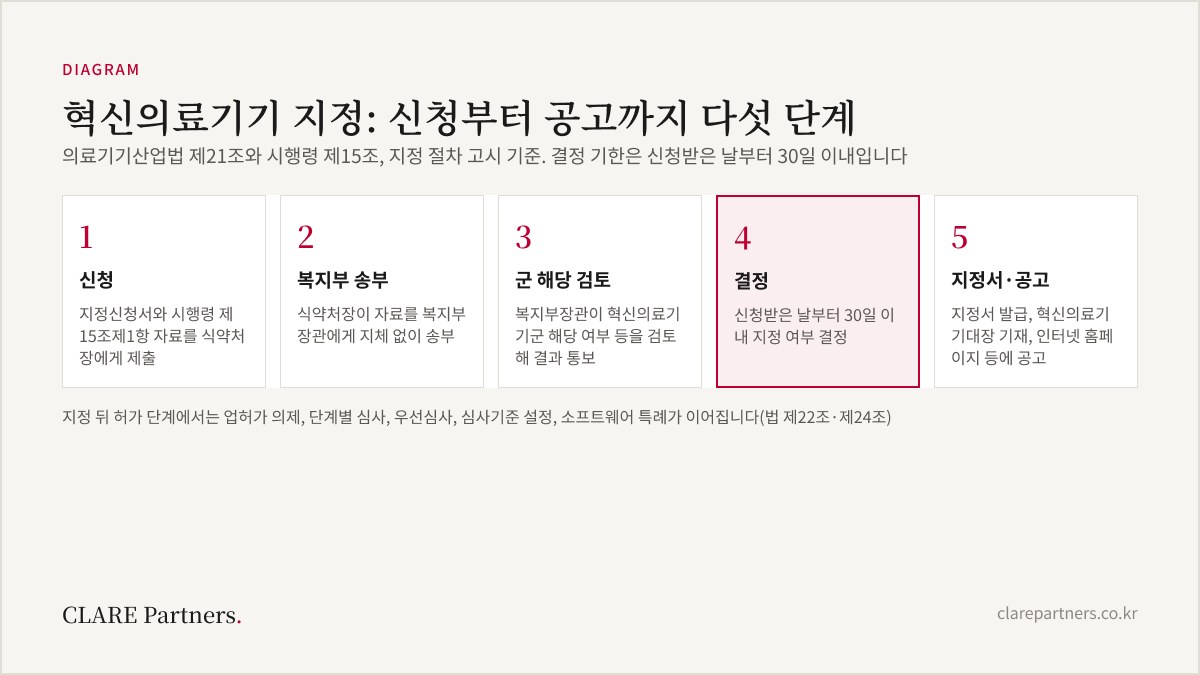
Where necessary for designation, the Minister of Food and Drug Safety may ask relevant institutions or experts for opinions or data (Article 15(3) of the Enforcement Decree). Also, where the Minister of Food and Drug Safety and the Minister of Health and Welfare agree that it is necessary, applications can be received during a set period under an integrated review that combines the designation review with confirmation of national health insurance coverage and a new health technology assessment, and in that case the scope, procedure and documents to be submitted are published on the MFDS website (Article 2(2) of the designation procedure notice). The new health technology assessment itself is covered in the new health technology assessment guide.
Special rules at the approval stage after designation
Designation does not replace approval. Article 22 of the Act attaches several special rules to the route towards approval.
| Special rule | What it provides | Basis |
|---|---|---|
| Deemed business licence | On obtaining manufacturing or import approval or certification, the company is deemed to hold a manufacturing or import business licence | Article 22(1) of the Act |
| Staged review | Review applied for in four stages before the approval application, each handled within 30 days of submission of the stage documents, with written notice within 7 days of completion | Article 22(2) of the Act, Article 3(3) and (5) of the Rules |
| Priority review | Reviewed ahead of other applications, limited to the review of technical documents or clinical trial data, with the request submitted together with the approval application | Article 22(5) of the Act, Article 4 of the Rules |
| Setting review standards | Where there are no applicable standards and specifications or they do not fit, the standards and specifications proposed by the applicant are reviewed and set as review standards | Article 22(6) of the Act, Article 5 of the Rules |
| Software special rule | Once certified as a medical device software manufacturer, part of the documents for approval are exempted | Article 24 of the Act, Article 7 of the special cases notice |
The four stages of staged review are product design and development review, safety and performance review, clinical trial protocol review, and technical documents and clinical trial data review (Article 22(2) of the Act). Article 3(1) of the special cases notice provides that the review ends on completion of the four stages, or of two stages where the product is subject to technical document review. The results of each stage are reflected at approval, but not if the safety and effectiveness data have changed after notice or new information on harm to the human body has emerged (proviso to Article 22(4) of the Act).
When priority review is requested, the review proceeds ahead of reviews already in progress, including those subject to expedited review. The Minister of Food and Drug Safety may designate a dedicated reviewer and, at the applicant's request, may support consultation and briefings on test standards, clinical data and supplementary matters (Article 6 of the special cases notice). For the approval procedure for the clinical trial protocol itself, see the clinical trial guide.
A preliminary review before the approval application is also available. Article 25(1)3 of the current Enforcement Rule of the Medical Devices Act includes medical devices designated as innovative medical devices (except where the designation has been cancelled) among those eligible for preliminary review. How the scope of preliminary review under Article 11 of the Medical Devices Act changes with the amendment taking effect on 10 December is covered in the summary of Act No. 21775.
Duties after designation: post-market surveillance and cancellation
The Minister of Food and Drug Safety may order a person who has obtained approval or similar for an innovative medical device to conduct post-market surveillance for a period of up to five years. This does not apply where the device is subject to post-market surveillance under Article 8(1) of the Medical Devices Act (Article 23(1) of the Act). On receiving the order, the company submits a surveillance plan within 30 days of the order (Article 6(2) of the Rules), reports the status of implementation within six months of conducting the surveillance (Article 23(2) of the Act), and submits a results report within 30 days of the end of the surveillance (Article 6(4) of the Rules).
Designation can be cancelled. It must be cancelled if it was obtained by false or other improper means, and it may be cancelled in consultation with the Ministry of Health and Welfare if the device no longer falls within an innovative medical device group, if maintaining the designation is found unnecessary, or if the device becomes subject to recall, disposal or similar under Article 34(1) of the Medical Devices Act (Article 21(5) of the Act). On cancellation, the designation certificate is returned without delay (Article 16(3) of the Enforcement Decree). The cancellation is notified to the Minister of Health and Welfare and posted on the MFDS website (Article 16(2)).
What to settle before applying
When considering innovative medical device designation, separate the statutory requirements from practical preparation. The statutory requirements are falling within a group, the criteria in Article 21(2) and the documents in Article 15(1) of the Enforcement Decree. For practical preparation, we recommend first fixing the comparator product and the improvement indicators, then mapping out, together with the development schedule, whether to use staged review, priority review only, or, for software, to go as far as manufacturer certification. The general approval route for software products is in the SaMD approval guide and the digital therapeutics guide.
If you send us the intended use, principle of operation and comparator data for the product you are developing, we will work through with you in a consultation whether it falls within an innovative medical device group, the designation application, and the order in which to use the special rules that follow.
Legal sources: Act on Nurturing Medical Devices Industry and Supporting Innovative Medical Devices (Act No. 21263, effective 1 July 2026) Articles 2 and 20 to 24 · Enforcement Decree of the same Act (Presidential Decree No. 35947, effective 2 January 2026) Articles 14 to 16 · Rules on the Support and Management of Innovative Medical Devices (Ordinance of the Prime Minister No. 1861, effective 31 January 2023) Articles 2 to 6 · Regulation on Procedures and Methods for Designating Innovative Medical Devices (MFDS Notice No. 2022-74) Articles 2 to 4 · Regulation on Special Cases for Approval of Innovative Medical Devices (MFDS Notice No. 2021-15) Articles 3, 4, 6 and 7 · Regulation on Designation of Innovative Medical Device Groups (Ministry of Health and Welfare Notice No. 2021-2) Article 2 · Enforcement Rule of the Medical Devices Act (Ordinance of the Prime Minister No. 2127) Article 25. Legal wording checked: 2026-11-09. Recommendations on how to prepare the application documents are practical opinions, not statutory requirements.
Frequently asked questions
- Q. What is the legal definition of an innovative medical device?
- Article 2, item 4 of the Medical Device Industry Act defines it as a medical device that has significantly improved, or is expected to significantly improve, safety and effectiveness compared with existing medical devices or treatments through the application of advanced technology in fields with high technology intensity and fast innovation, such as information and communication technology, biotechnology and robotics, or through improved methods of use, and that has been designated by the Minister of Food and Drug Safety under Article 21. New technology alone does not make a product an innovative medical device; it must be designated.
- Q. Once designated as an innovative medical device, is approval no longer needed?
- No. Even after designation, the product must still obtain manufacturing or import approval or certification under the Medical Devices Act. The special rules attach to that process. They include staged review before the approval application, priority review and the setting of standards and specifications, and once product approval or similar is granted, the company is deemed to hold a manufacturing or import business licence (Article 22 of the Medical Device Industry Act).
- Q. Where is the list of designated innovative medical devices published?
- Article 21(4) of the Medical Device Industry Act requires the Minister of Food and Drug Safety to publish information on designated innovative medical devices on the website or similar. The notice includes the designation number, the date of designation and the product name, item name and model name, and for a cancellation, the date of and reason for cancellation (Article 4 of the Regulation on Procedures and Methods for Designating Innovative Medical Devices).
- Q. Can a company that imports a product manufactured overseas also apply?
- Article 21(1) of the Medical Device Industry Act provides that a person who wishes to have a medical device within an innovative medical device group designated applies, and Article 22(1) sets special approval rules for a person who intends to manufacture or import an innovative medical device. Even for an imported product, whether it falls within an innovative medical device group and the designation criteria are reviewed in the same way.